

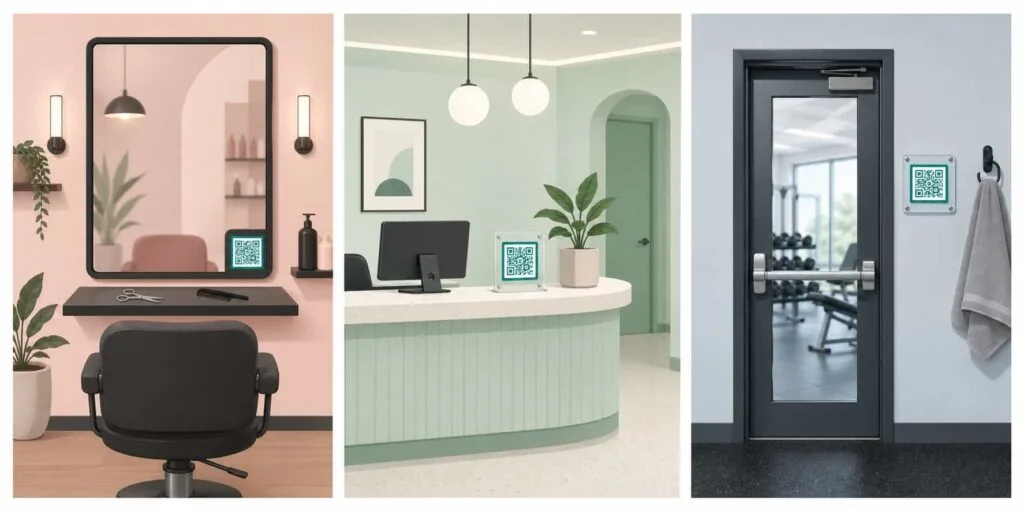
A stylist removes the cape. The client looks in the mirror, tilts their head, smiles. That is the moment. In 30 seconds they will pick up their phone to take a selfie. In 60 seconds they will be at the register paying. In 3 minutes they will be out the door and the moment is gone. If there is no QR code on that mirror, you just lost a five-star review from someone who was literally holding their phone and feeling great about what you did.
Salons, clinics, and gyms share something restaurants do not: the service itself creates an emotional peak that is deeply personal. A new haircut changes how someone sees themselves. A successful treatment brings relief. A hard workout triggers an endorphin rush. These are not transactional moments. They are transformation moments. And transformation moments produce the most detailed, authentic, keyword-rich reviews Google has ever seen.
The problem is the same across all three: the peak fades fast. Satisfaction scores measured within 15 minutes of service completion are 34% higher than those measured 24 hours later. The gym member who just set a personal record is 4.2x more likely to leave a review in the next 18 minutes than later that evening. A Google review QR code placed at the exact right spot turns these fleeting moments into permanent five-star reviews.
Capture the Moment Before It Fades
VISU QR Ads gives salons, clinics, and gyms dynamic QR codes with scan analytics. See which stations drive reviews. Adjust destinations without reprinting.
Three Businesses, Three Emotional Peaks, One Strategy
Every service business has a specific moment when the client feels the highest satisfaction. In salons, it is the mirror reveal, the instant the cape comes off and they see the transformation. In clinics, it is the relief after a procedure, the moment a patient hears good results or walks out pain-free. In gyms, it is the post-workout high, the 15 to 20 minutes after a tough session when endorphins are flooding the brain.
These peaks are not interchangeable. A gym QR code at the entrance fails because the member has not done anything yet. A clinic QR code in the pre-appointment waiting room asks for a review of a service that has not happened. A salon QR code on the front desk misses the mirror moment entirely. The right placement for each business type is determined by when and where the emotional peak occurs.
The data backs this up. Barbershops that place QR codes at mirror stations and train barbers to mention them during the reveal collect 10 to 25 reviews per week. Gyms that place codes at the exit door and have coaches prompt after class see 8 to 12% scan rates from attendees. The specific numbers differ, but the principle is universal: intercept the client at the peak and make the review frictionless.
Salons and Barbershops: The Mirror Reveal
Salons have the most visually powerful review trigger of any business. The client sits in the chair staring at one spot for 20 to 45 minutes. When the stylist finishes, the cape comes off and the client sees themselves transformed. Their phone is out within seconds, usually for a selfie. If there is a QR code on that mirror, the path from selfie to review is one scan.
A Reddit salon owner shared what happened after putting QR codes on every mirror: "A week later every mirror in my salon had a QR code that goes to our review page. Small gift offer for next visit. No awkward asking." The result was a steady stream of reviews without the uncomfortable verbal request that most stylists dread. The mirror does the asking for you, silently, for every single client.
Barbershops have an even stronger advantage. A barber sees 15 to 25 clients per day. If even 20% leave a review, that is 15 to 25 new reviews per week. At that rate, a shop reaches 100 reviews in 4 to 8 weeks and 300 or more in 6 months. A barbershop with 300 Google reviews is virtually untouchable in local search. The key placements are mirror station (primary, visible for the entire appointment), checkout counter (secondary, phone already out for payment), and a business card with QR on the back (follow-up for clients who did not scan at the mirror). For broader salon marketing strategy, see our guide on how to get more clients for your salon.
Clinics and Health Services: The Relief Moment
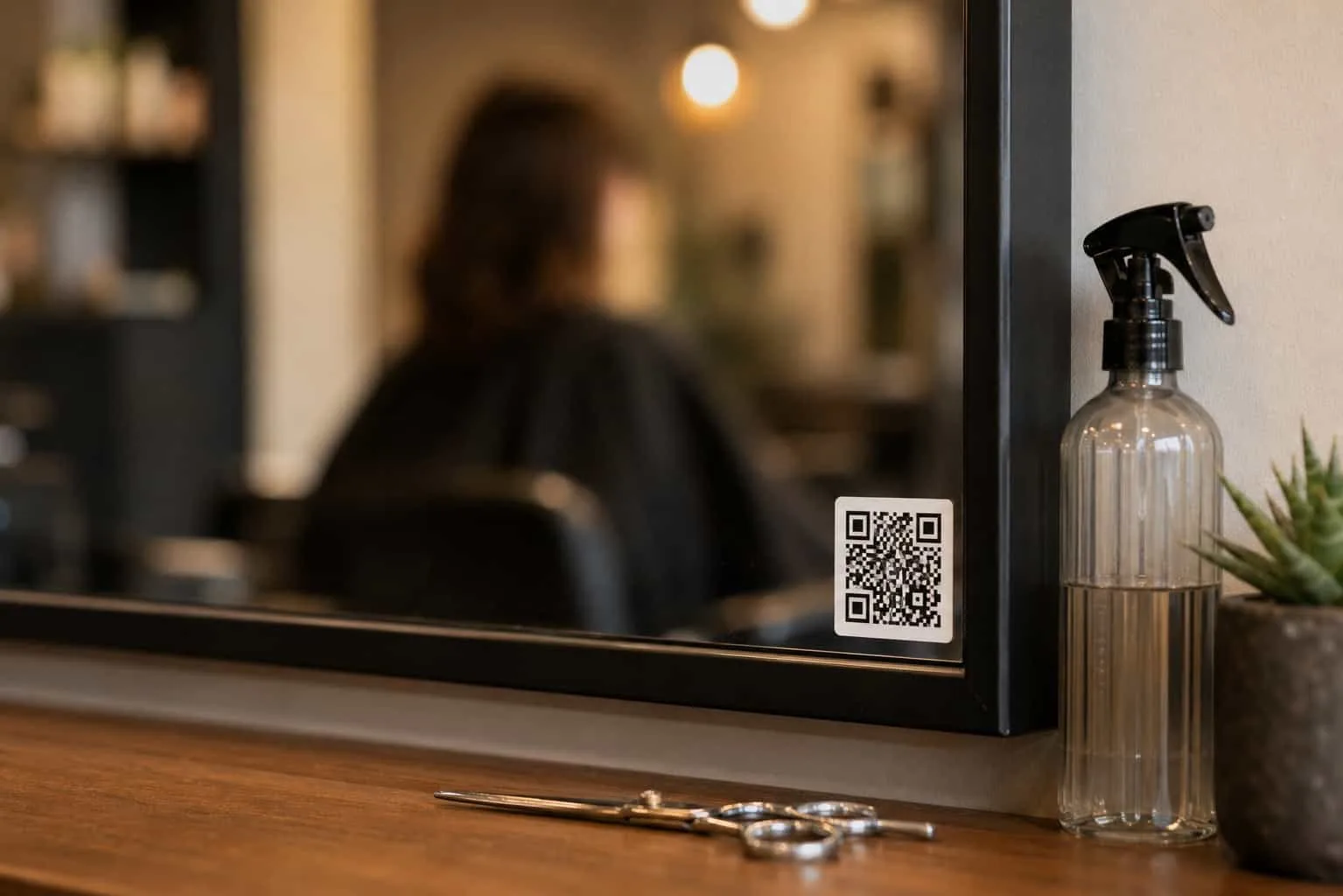
Clinics face a timing challenge that salons and gyms do not. The pre-appointment waiting room is the wrong moment because the patient has not received the service yet. Asking for a review before the consultation or treatment is premature and can feel presumptuous. The right moment is after: the post-consultation checkout, the discharge area, or the follow-up communication.
QRLynx's healthcare QR analysis found that 80% of a practice's QR use cases fall into what they call Tier 3: waiting-room "join our patient portal" codes, after-visit "leave a review" codes, and appointment-reminder codes. The after-visit code is the one that matters for reviews. Place it at the checkout desk where the patient schedules their next appointment, on the discharge paperwork they take home, or on a small acrylic stand in the post-consultation area. The patient is processing relief ("the results were good," "the pain is better," "the procedure went well") and is emotionally available to share that feeling.
For dental offices, dermatology clinics, physiotherapy practices, and wellness centers, the pattern is the same. The patient finishes their session, walks to the front desk, and has 1 to 3 minutes of idle time while payment processes or the next appointment is booked. That idle moment at the desk, phone in hand, is when the QR code converts. Dentists who implement QR codes at checkout realistically collect 3 to 8 reviews per week. It is not the volume of a barbershop, but for a practice that sees 10 to 20 patients daily, it compounds fast. For related strategies, see our guide on marketing for clinics.
One System for Every Service Type
VISU QR Ads works for mirror stations, checkout desks, and gym exit doors. Dynamic codes, real-time scan tracking, no reprinting when you pivot.
Gyms and Fitness Studios: The Post-Workout High
The post-workout high is an 18-minute window after a hard session when endorphins peak and the member feels invincible. This is not a metaphor. ReviewQR data shows gym members are 4.2x more likely to leave a review after achieving a personal goal than at any other time. The trigger is not what you did for them. It is what they did in your space. That distinction makes gym reviews uniquely personal and emotionally charged.
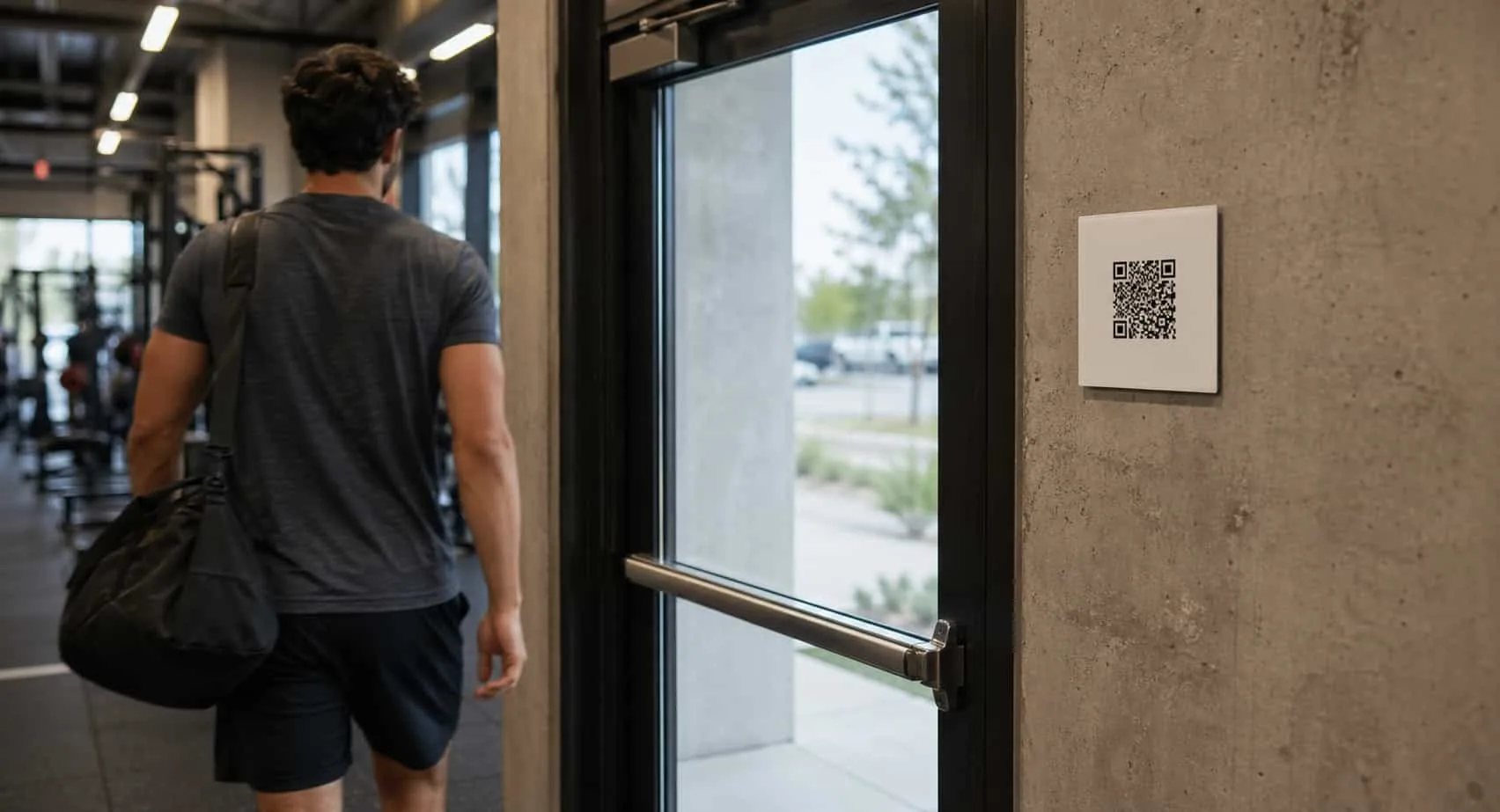
The exit door is the highest-converting placement because every member walks past it while still riding the high. A simple wall-mounted sign at eye level ("Loved today's workout? Scan to review us") catches the 10 to 15 second transition between finishing and leaving. Other strong spots: front desk at check-in or check-out, locker room mirrors (members checking themselves after a session, feeling good), the water fountain or hydration station (natural 10 to 30 second pause), and the whiteboard or results board in CrossFit boxes and HIIT studios where members log scores.
Group classes have a built-in advantage: social momentum. When the whole class is high-fiving and celebrating, the energy is contagious. A coach who ends class with "If you loved that, scan the QR by the door on your way out" gets 8 to 12% of attendees to scan. Solo gym members are harder to reach (2 to 4% without prompts) but respond well to milestone triggers: "You just hit 50 sessions this year!" A case study from a CrossFit studio in Denver showed reviews jumping from 23 to 89 in 90 days, trial class sign-ups increasing 31%, and 60% of all reviews coming from the exit door code combined with a coach prompt. For strategies on retaining these members long-term, see gym marketing and loyalty.
Staff Scripts That Feel Natural, Not Corporate
The verbal prompt increases scan rates by 40% across all three business types. But the delivery has to match the energy of the environment. A CrossFit coach does not speak like a dental receptionist, and neither should speak like a robot reading a corporate script.
For stylists and barbers, the ask happens during the reveal. The client is looking in the mirror, happy. The stylist says something like: "You look amazing. If you get a sec, there's a QR code on the mirror, takes like 20 seconds and really helps us out." For regulars: "You've been coming here for a while now. If you haven't left us a Google review yet, it would mean a lot. Helps other people find us." The key is matching the tone of your shop. If the vibe is warm and chatty, be warm and chatty. If it is laid-back and cool, keep it laid-back.
For clinic receptionists, the ask happens at checkout. The patient has just finished their appointment and is scheduling the next one or processing payment. The receptionist says: "Glad everything went well today. If you have a moment, there's a QR code here if you'd like to share your experience on Google. It helps other patients find us." The tone is calm, professional, and optional. Never pressure a patient. Health environments require extra sensitivity.
For gym coaches, the ask happens at the end of class or session. The energy is high. The coach says: "Incredible work today. If you crushed it, scan the QR by the door and let the world know. Helps us bring in more people like you." For personal trainers after a one-on-one session: "That was a great session. If you want to give a shout-out, the QR code is right there. Takes 15 seconds." The "help us find more people like you" framing works exceptionally well in fitness because it appeals to community identity. For more on how QR codes for salons, gyms, and clinics work across all these environments, see our practical guide.
Placement Comparison by Business Type
| Business | Emotional Peak | #1 Placement | #2 Placement | #3 Placement | Reviews/Week |
|---|---|---|---|---|---|
| Barbershop | Mirror reveal | Mirror station | Checkout counter | Business card back | 10-25 |
| Hair salon | Mirror reveal | Mirror station | Checkout counter | Follow-up text | 5-10 |
| Nail salon / Spa | Service completion | Service station | Checkout counter | Packaging insert | 5-8 |
| Dental clinic | Post-procedure relief | Checkout desk | Discharge paperwork | Follow-up SMS | 3-8 |
| Dermatology / Physio | Treatment outcome | Post-consultation area | Checkout desk | Follow-up email | 3-6 |
| CrossFit / HIIT studio | Post-workout high | Exit door | Whiteboard / results | Coach verbal prompt | 8-15 |
| Standard gym | Session completion | Exit door | Locker room mirror | Front desk | 5-10 |
| Yoga / Pilates studio | Post-class calm | Exit area | Reception desk | Instructor prompt | 3-6 |
Five Mistakes That Kill Your Scan Rate
The first and most common: not asking. The QR code on the wall helps, but adding a 5-second verbal mention increases scan rates by 40%. The code alone is passive. The code plus a human prompt is active. Most salons, clinics, and gyms place the code and never mention it again. The ones that train staff to mention it casually see dramatically different results.
Second: asking at the wrong moment. A clinic QR code in the pre-appointment waiting room asks for a review of a service that has not happened. A gym code at the entrance catches members before they have done anything. A salon code at the front door is seen on the way in, not on the way out. The emotional peak has a specific location in your business. Put the code there, not wherever is convenient.
Third: offering discounts for reviews. "Leave a review, get 10% off" violates Google's Terms of Service and can get your listing flagged. Do not risk your entire profile for a few extra reviews. Great service plus a natural ask at the right moment produces reviews without incentives. The mirror reveal, the post-workout high, and the relief moment are all the incentive a happy client needs.
Fourth: ignoring review responses. An unanswered review, especially a negative one, tells future clients you do not care. Respond to every review within 24 hours. For positive reviews, keep it personal and mention the staff member by name if the reviewer did. For negative ones, acknowledge, apologize, and take the conversation offline. The way you respond is visible to every potential client reading your reviews.
Fifth: using a static QR code with no tracking. If you do not know how many people scanned, which placement generated the most reviews, or whether the link still works, you are flying blind. A dynamic code lets you measure, compare, and optimize. For the full breakdown of why static codes fall short, see our analysis of best placement for review QR codes.
Mirror. Checkout. Exit. Covered.
VISU QR Ads delivers dynamic, trackable QR codes for every touchpoint in your salon, clinic, or gym. Real-time data. No reprinting. Just more reviews.
Frequently Asked Questions
Which business type collects reviews the fastest?
Barbershops have the highest review velocity of any local business. A barber sees 15 to 25 clients per day, and with QR codes at every mirror and a verbal prompt during the reveal, busy shops collect 10 to 25 reviews per week. That means reaching 100 reviews in 4 to 8 weeks. Gyms with group classes are next at 8 to 15 per week. Clinics are slower (3 to 8 per week) due to lower daily patient volume, but the reviews tend to be longer and more detailed.
Should I put a QR code in the waiting room?
Not for reviews. The patient or client has not received the service yet, so a review request is premature. Waiting room QR codes work well for other purposes: check-in, health forms, Wi-Fi access, or entertainment. Save the review QR code for the post-service area where the client has just experienced the emotional peak.
How do I handle asking for reviews in a medical setting?
Keep it calm, professional, and entirely optional. The receptionist at checkout says something like: "If you had a good experience today, there's a QR code here if you'd like to share it on Google." Never pressure a patient. Health settings require extra sensitivity around feedback requests. The QR code on the desk does most of the work without requiring any conversation at all.
Can personal trainers and individual stylists benefit from this?
Absolutely. Personal trainers who prompt after great sessions generate 3 to 5 reviews per month. Stylists with a QR code at their individual station build a personal review profile within the salon's listing. When clients mention the trainer or stylist by name in the review, it helps that professional attract more bookings and helps the business rank for more specific searches.
What if my gym members are wearing headphones and not social?
Solo gym members scan at 2 to 4% without prompts, which is lower than group class attendees. The solution is milestone triggers: use your gym management software to flag when a member hits 10 sessions, 50 sessions, or a personal best. The system alerts the front desk or a trainer, who then delivers a brief congratulation with a review prompt. These milestone-triggered reviews tend to be the most detailed and emotionally rich because they anchor to a personal achievement.