

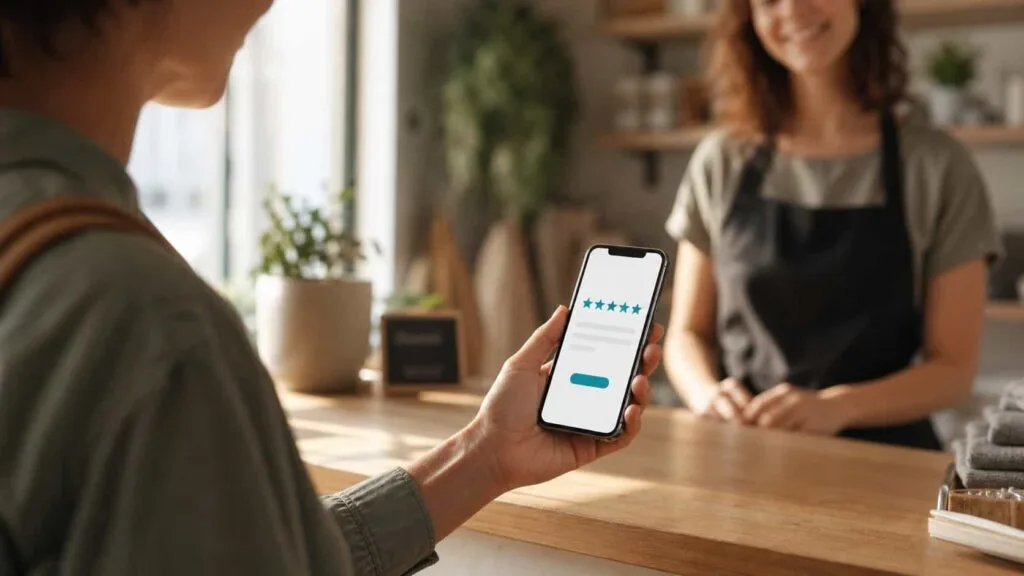
Most of your happy customers will never leave a review. Not because they didn't love what you do. Because nobody made it easy, nobody asked at the right moment, and nobody gave them a reason to bother. Fixing that gap is the single highest-leverage thing you can do for your local business this year.
Here is the part that nobody likes to admit. Your best customers are quiet. They paid, they smiled, they left, and they probably told one or two friends about you. That is it. The loud ones are usually the unhappy ones, the people who go online specifically to vent. So if you let things happen naturally, your Google profile starts looking like a complaint board with a few five-star reviews mixed in. That is not a real picture of your business. That is just the loudest 5% of your customers having a microphone while the other 95% are eating their meal in peace and going home.
The good news is that this is not a personality problem or a marketing budget problem. It is a process problem. When you ask the right people at the right time and remove the friction in between, satisfied customers will leave reviews. They are not refusing. They are just busy, and you never gave them a reason to stop and do it. This guide walks through what actually works, why it works, and how to set it up in your business this week.
Make Asking Effortless
VISU QR Ads turns review requests into a single tap. No links to type, no logins to fight, no awkward pitch. Just a clean path from happy customer to public review.
Why Your Happy Customers Stay Quiet
There is a quiet asymmetry in how online reviews work, and once you see it you cannot unsee it. People who are angry have a reason to act. They want to warn others, they want a refund, they want someone to know. People who are happy have nothing to act on. The transaction is over, they got what they came for, and their brain has already moved on to whatever is next in their day.
BrightLocal's consumer survey puts the gap in plain numbers. Around 72% of customers will leave a review when asked, but only a fraction ever does it on their own. The action requires a nudge. Not pressure, not bribery, just a small reminder at a moment when the experience is still fresh in their head and their phone is already in their hand.
The other reason happy customers stay quiet is that they don't think their review matters. They assume you have plenty already. They assume one more star will not move the needle. They are wrong, but you have to tell them. A single line like "your review really helps a small business like ours show up on Google" reframes the request from a favor for you into a small act of community support, which is a much easier yes for most people. If you want a deeper playbook on this, our guide on how to get Google reviews walks through the full system.
The Timing Window That Changes Everything

There is a real, measurable window where review requests convert best. It opens the moment the customer feels the value of what you delivered and closes a few hours later when normal life floods back in. Restaurants, this is when the plates are cleared and the customer is leaning back happy. Salons, this is when they are still looking at themselves in the mirror after the cut. Clinics, this is when the worry is replaced by relief. You know this moment in your own business if you pay attention.
Asking inside that window is the difference between a 25% conversion and a 5% conversion. Same customer, same level of happiness, completely different result. That is because in the window, the positive feeling is doing the work for you. The customer is not deciding whether you deserve a review. They already feel it. All you are doing is giving the feeling somewhere to go.
Outside the window, you are asking a different person. Not literally, but functionally. They have moved on, they are thinking about pickup or dinner or work, and your request now feels like a chore. They will say yes to be polite, mean it sincerely in that moment, and then forget by the time they are home. This is why the email follow-up alone almost never works as well as a well-timed in-person ask combined with an easy way to act on it.
How to Ask Without Sounding Desperate
The biggest reason owners avoid asking is that they imagine the worst version of themselves doing it. They picture a sweaty pitch, a customer rolling their eyes, an awkward pause. That version is not the only option. The version that actually works is short, casual, and embedded in a normal conversation. It does not feel like a sales pitch because it isn't one.
The structure has three parts and takes about ten seconds. First, you acknowledge the moment with a sincere comment about their experience. Second, you make the small ask in plain language. Third, you remove the path of least effort by handing them the way to do it right now. That is it. No script memorized, no follow-up close, no negotiation. If they say no or hesitate, you smile, say no problem, and move on. The whole thing should feel like you mentioned it almost in passing.
What kills the ask is treating it like a transaction. The moment you feel like you are owed something, the customer feels it too, and the warmth disappears. The right framing in your own head is that you are inviting them to do something small that helps you, and they are absolutely free to say no. People can sense the difference between an invitation and a demand, even when the words are identical.
Stop Hoping. Start Asking the Easy Way.
Hand a customer the QR code at the right moment and watch reviews stack up. VISU QR Ads tracks every scan so you know exactly what is working.
Removing the Friction Between Yes and Submit
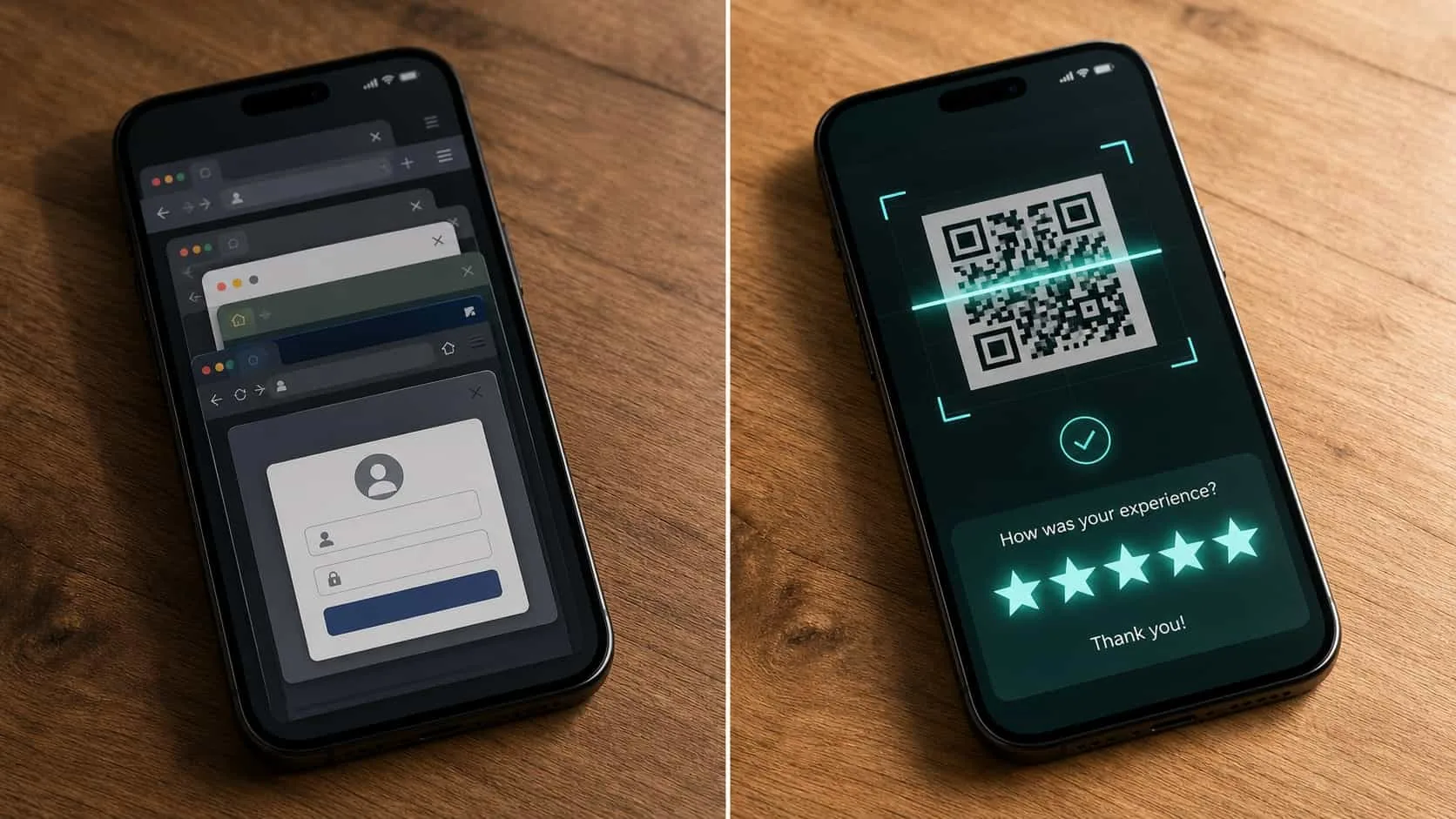
A customer who agrees to leave a review still has to actually do it, and that is where most of them quietly disappear. Imagine the steps from a verbal yes to a published review. Open the app store or browser, search for your business, find the right one out of three or four similar listings, scroll down, find the review section, sign in to Google if not already, type, submit. Each step is a chance for them to drop off, get a notification, change their mind, or just decide to do it later and never come back.
This is the entire reason a Google review QR code exists. It compresses that whole sequence into one motion. Customer pulls out their phone, points the camera, the review page is open. From eight steps to one. And the difference in conversion is not 10% or 20%, it is multiples. Static codes work, but dynamic ones let you see exactly how many scans you got, when, and from where, which lets you tell the difference between "we asked and nobody did it" and "they tried but the page failed to load."
If you run a restaurant specifically, the placement and design of these codes matter even more because customers are sitting still and have time to act. Our breakdown of review QR codes for restaurants covers the table-tent versus check-folder question and the small design choices that lift scan rates without redesigning your branding.
Getting Your Team to Actually Do It
Owners forget how strange asking for a review feels to a new employee. They have not built the relationship, they don't know if the customer was actually happy, and they are scared of that awkward moment where the customer says no. So they don't ask. And then the owner wonders why review counts dropped when they hired help. The team is not lazy. They are uncomfortable, and nobody trained them through it.
The fix is not a memo. The fix is showing them what it looks like when you do it well, then letting them practice on a couple of low-stakes customers while you watch. Most people get the hang of it after three or four real attempts. The script feels weird the first time and feels like nothing the tenth time. After that, the only thing that keeps the habit alive is some kind of light visibility, like a weekly count on a whiteboard or a quick mention in a Monday huddle.
Tying it loosely to incentives helps but should not be the whole reason. A small bonus for the team when monthly review counts hit a target works. Paying per review tends to backfire because it pushes people to ask anyone, including unhappy customers, which produces the opposite of what you want. Keep the incentive about the team, not the individual, and keep it about volume of asks rather than volume of five-star results.
Scripts That Work in Real Conversations
Generic scripts feel like generic scripts, and customers can tell. The ones that actually convert sound like something a human would say to another human at the moment of the ask. Here are a few that work in different settings, lightly worded so you can adjust them to your own voice instead of reading them off a card.
Restaurant, after dessert or paying the bill: "Hey, really glad you enjoyed it tonight. If you have thirty seconds, a quick Google review honestly helps us a lot. There is a code right here on the table if you want." Then you walk away. You do not stand there waiting. The walk-away is what makes it not feel like pressure.
Barbershop or salon, while finishing up: "You happy with how it turned out? Awesome. If you ever feel like leaving us a quick Google review, the QR is on the mirror right there. Helps a small shop like ours a ton." This works because they are literally looking at themselves liking the result while you say it.
Clinic or service business, at checkout: "By the way, if you wouldn't mind leaving us a review on Google, it really helps other people find us. No pressure at all, but if you have a second the link is on your receipt." The "no pressure at all" line does heavy lifting. It signals that the relationship is not transactional.
Notice what these have in common. They are short, they include a reason that is about you, not them, and they always end with a clear easy action. They never include "five stars" or "if you had a great experience" because both phrases imply a conditional review and feel manipulative. Let the customer decide what to write. If you delivered, the rating handles itself. For more on the psychology side and how to use Google reviews to attract customers once you have them, see our guide.
The Follow-Up Nobody Sends (and Should)
Even with great timing and a clean QR code, some customers will say yes and then forget. That is not a failure of your process, that is just life. The fix is a short follow-up message a few hours later or the next morning, sent through whatever channel the customer already opted into, usually a confirmation email or a booking SMS. One line, no graphics, no marketing fluff. Just a friendly reminder with the link.
The trick is volume and tone. Volume, meaning send it once, not three times. Three messages turn into spam fast. Tone, meaning write it like a person, not a marketing department. Something like "Thanks again for coming in today. If you have a sec, here's the Google review link, would mean a lot." That converts. The fancy templated version with three buttons and a banner image does not.
The follow-up also catches a specific group of customers who would never leave a review during the visit because they were rushed, but happily do it from the couch that evening when they have ten quiet minutes. You are not adding pressure, you are giving them a second chance to act on something they already wanted to do. And if they ignore the follow-up, you let it go. Forever. Asking again past that point is where the line gets crossed.
Mistakes That Quietly Kill Your Conversion
Asking only your closest customers. The instinct is to ask the regulars who love you because they will definitely say yes. Problem is, those people often already left a review long ago. Your real upside is the new customer who just had a great first visit. They have the highest emotional charge and the lowest review count, and they are exactly the people most owners forget to ask.
Filtering for five stars. Some businesses send unhappy customers to a private feedback form and only steer happy ones toward Google. Google considers this review gating and it can get your reviews removed or your profile penalized. It also makes your rating look fake over time. Ask everyone. Address complaints quickly when they come, and learn how to respond to Google reviews in a way that turns even rough ones into trust signals.
Letting the QR code go stale. Codes get bent, covered, peeled off, or knocked behind a planter. A code nobody can scan is the same as no code. Walk through your space once a week and look at every code from a customer's seat. If you cannot scan it from where they sit, it is broken in practice even if it works in theory.
Pressuring customers who hesitate. A pause is a no. The moment you feel yourself trying to argue them into it, you have already lost the next ten reviews from that customer's social circle, because they will tell people you got weird about it. Smile, move on, ask the next person.
Forgetting to thank the people who actually wrote one. A short reply on Google to every review, even the four-star ones, signals to future readers that a real human runs the place. It also makes the reviewer feel seen, which makes them more likely to come back and recommend you in person, which is where the real growth lives.
Your Happiest Customers Are One Tap Away From Telling the World
VISU QR Ads removes the friction between satisfaction and submission. Real-time tracking, clean placements, and a path that converts.
Frequently Asked Questions
What is the best time to ask a customer for a review?
Right at the peak of their satisfaction, before they leave. For restaurants this is around dessert or paying the bill. For salons it is the mirror moment. For clinics it is at checkout when relief has set in. Asking in person at this moment converts at roughly 25%, while a cold email a week later usually lands under 5%. The window matters more than the script.
Should I offer a discount or freebie in exchange for a review?
No. Google's policy prohibits incentivized reviews and they can remove them or penalize your profile. Beyond the policy, incentivized reviews tend to be shorter, less specific, and read as fake to other customers. The trust you lose is bigger than the volume you gain. Stick to a sincere ask and an easy path to act.
What if a customer agrees but never leaves the review?
That is normal and not personal. Send one short follow-up message the next day with the link. If they still don't, drop it. The cost of pushing harder is much higher than the value of the one missed review, and persistent customers are usually the ones who tell their friends about you anyway.
Is a QR code really necessary or can I just send a link?
A link works in email and SMS. A QR code wins in person because the customer is right there with their phone out. Use both, in the channel that fits the moment. The point is to never make the customer search, type, or hunt for your business in Google's listings.
How many reviews per month is realistic for a small business?
If you have steady weekly traffic and a clean ask system, two to four new reviews per week is achievable for most local businesses, which adds up to ten to fifteen per month. Restaurants and salons with high volume can push higher. The number matters less than the consistency, since Google rewards a steady review velocity more than a single spike.