


Nextdoor has more than a hundred million registered neighbors and 21 million weekly actives, a number that fell 5 percent last year. That gap is the whole problem with community software in one statistic. This guide compares the main platforms with their published prices, explains why participation looks the way it does, and covers what the research says about communities that meet in person rather than on a screen.
For Communities That Meet Somewhere Real
VISU works on attendance and return, the two things the research says build connection, and the two a forum cannot reach.
What a Community App Actually Is
A community app gives a group its own space to talk, share and organize gatherings. Member profiles, a feed or forum, and events.
It differs from a social network because the group is closed and whoever runs it sets the rules. It differs from membership management software because the focus is interaction, not billing and records.
Search results for this term hide an ambiguity worth clearing up first. Two different products share the name.
- An app to build a community. Software you rent to run your own group. Circle, Mighty Networks, Discourse. This is what most of this guide covers.
- The app of a specific community. A building's resident app, a senior living app, a neighborhood network. You join one rather than operate it.
Worth noticing which examples fall in that second group. They are almost all tied to a physical place. That pattern matters later.
The Main Community Platforms, Compared
Prices below were read from each vendor's own pricing page. Where a vendor does not publish pricing, that is noted rather than guessed.
Built for creators and course businesses
- Circle. Professional at 89 dollars monthly with a 2 percent transaction fee, Business at 199 with 1 percent. Members are unlimited, but extra admins cost 10 dollars monthly each and moderators come in paid blocks. Moderation scales in cost.
- Mighty Networks. Launch at 79 dollars monthly with a 2 percent fee, Scale at 179 with 1 percent. Unlimited members on every plan. A white-label app requires Mighty Pro, which is quoted rather than published.
- Skool. Hobby at 9 dollars monthly, Pro at 99. Deliberately minimal, with a single feed, courses and a calendar.
- Heartbeat. Build at 49 dollars monthly, or 40 monthly billed annually. No-code and private.
Built for companies and large organizations
- Bettermode. Starter at 399 dollars monthly for up to 10,000 members, Growth at 1,500 for up to 25,000. The only platform here that caps members by plan.
- Hivebrite. Alumni networks and associations. No public pricing, quote only, and implementation expects a dedicated team.
- Discourse. Free self-hosted and fully open source. Hosted Pro at 100 dollars monthly for 5 staff seats, Business at 500 for 15. A forum rather than an app, and the only option here that is genuinely indexable by search engines.
Free, with a catch
- Discord. Free to run a server. You do not own the data or the relationship, content is not indexable, and there is no native way to charge for access or export your members.
- Slack. Free tier with limited history, paid per active user. Per-user pricing makes a large free community economically impossible.
The pricing trap worth doing the math on
Almost every platform charges a subscription plus a percentage of what you earn. The percentage drops as the subscription rises.
Skool shows this most sharply. Hobby costs 9 dollars monthly but takes 10 percent of transactions. Pro costs 99 monthly and takes 2.9 percent.
Run the arithmetic and the cheap plan stops being cheap at roughly 1,100 dollars of monthly revenue. Above that, the 9 dollar plan costs you more than the 99 dollar one.
The same shape applies at Circle, Mighty Networks and Heartbeat. Compare total cost at your actual revenue, not the sticker price.
Six Criteria That Survive Contact With Reality
Who owns the data. Discourse documents a full database export and can be self-hosted. On Discord and Facebook Groups you cannot take your members with you. If the relationship matters, this is the first question, not the last.
Real cost per member. Subscription plus transaction fee plus per-seat add-ons. See the arithmetic above.
Moderation cost. Circle bills moderators as add-ons and Discourse bills staff seats by plan. A volunteer-run local group hits those ceilings quickly.
In-person events. No platform in this comparison treats a physical gathering as a first-class object. Events exist as another kind of post. None has check-in, proof of attendance or a reward for showing up at its core.
Mobile. Distinguish having an app from having your own branded app. Mighty Networks only offers the latter on its quoted tier.
Monetization. Every paid platform takes a cut. Discord and Slack have no native way to charge for community access at all.
Counting Posts Measures the Wrong Thing
If your members show up in person but never write a word, attendance is the signal worth capturing.
The Engagement Problem No Listicle Mentions
Pick any platform and most of your members will never post. That is not a failure of your community management. It is the default behavior of online groups, and it has been documented for two decades.
Jakob Nielsen described the pattern in 2006 as participation inequality. 90 percent read without contributing, 9 percent contribute occasionally, and 1 percent produce nearly all the content.
The supporting numbers are stark. On Wikipedia, 99 percent of visitors only read. Among the 32 million unique visitors at the time, roughly 68,000 active contributors amounted to 0.2 percent.
Nielsen's own caveat matters as much as the rule. The inequality cannot be eliminated. Good design shifts the curve, it does not flatten it.
Some vendors argue the rule is outdated. Higher Logic reports around 33 percent contributing in communities under 5,000 members. That figure comes from its own paying customer sites, with no published sample size or method, so treat it as vendor data rather than a refutation.
The number that settles it
Nextdoor is the largest place-based digital community in the world, and it is a public company, so its figures are audited rather than marketed.
In its fourth quarter 2025 results, published February 2026, Nextdoor reported 21.0 million weekly active users, down 5 percent year over year, against more than a hundred million registered neighbors. Revenue was 258 million dollars for the year, with a net loss of 54 million.
Roughly four out of five registered neighbors do not show up in a given week. And the active number is shrinking.
Nextdoor's own CEO framed the strategy shift around this. The value, in his words, is not in passive scrolling but in high-intent moments.
Registering a neighborhood in an app is not the same as getting the neighborhood to show up.

What the Research Says About Online Versus In Person
Two peer-reviewed studies published recently speak directly to this, and both point the same way.
Live events build connection, but only under specific conditions. A 2025 study in Social Psychological and Personality Science measured 1,551 participants before and after events including concerts, fitness classes and workshops.
Three factors reliably predicted social connection. Attending in person rather than virtually. Participating actively rather than passively. Going with someone rather than alone. Recurring events outperformed one-off ones.
Active participation was the strongest predictor of all.
Then comes the finding that reframes the category. The gain in connection did not hold 24 hours after the event.
If connection decays that fast, the thing that builds community is not the conversation between gatherings. It is whatever brings the person back next week.
Local gatherings succeed because of the place, not the software. A 2026 study in Cities analyzed more than a million events across the 500 largest US cities using Meetup data.
Its central finding: participant engagement is driven mainly by characteristics of the community and the place itself. Organizer-side outcomes depend on a wider mix of factors.
That is an uncomfortable result for the premise behind every platform comparison, including the one above. Choosing the right software does not make a local community happen.
There is also a demand signal worth citing carefully. Research commissioned by Eventbrite, surveying 4,051 people aged 18 to 35 in the US and UK, found 89 percent want events that connect them to their community. It is vendor-commissioned research, but it publishes its sample and method, which most does not.
If Your Community Has an Address, You Have a Different Problem
Everything above assumes your community lives on a screen. Many do, and for those the comparison table is the answer. Pick Circle or Skool or Discourse, and this guide is done being useful.
But if your community meets somewhere real, a gym, a church, a court, a neighborhood, a local business, the research points somewhere else.
Community platforms solve conversation between gatherings. A place-based community needs to solve the gathering itself. Showing up, being recognized, having a reason to come back.
Those are different problems, and the evidence says the second one is what produces connection.
The economics do not fit either. Bettermode starts at 399 dollars monthly and Hivebrite quotes from higher. A local court or a neighborhood shop does not carry that. And the cheap plans take 10 percent of revenue from businesses running on local margins.
Meanwhile a forum for the neighborhood gym will show the same 90 percent who never post. Except those people do turn up at the gym. The forum is measuring the wrong thing.
Where VISU Fits
VISU is not a forum and not a membership management system. It does not compete with Circle or Discord, and if your community is genuinely online, those are better tools.
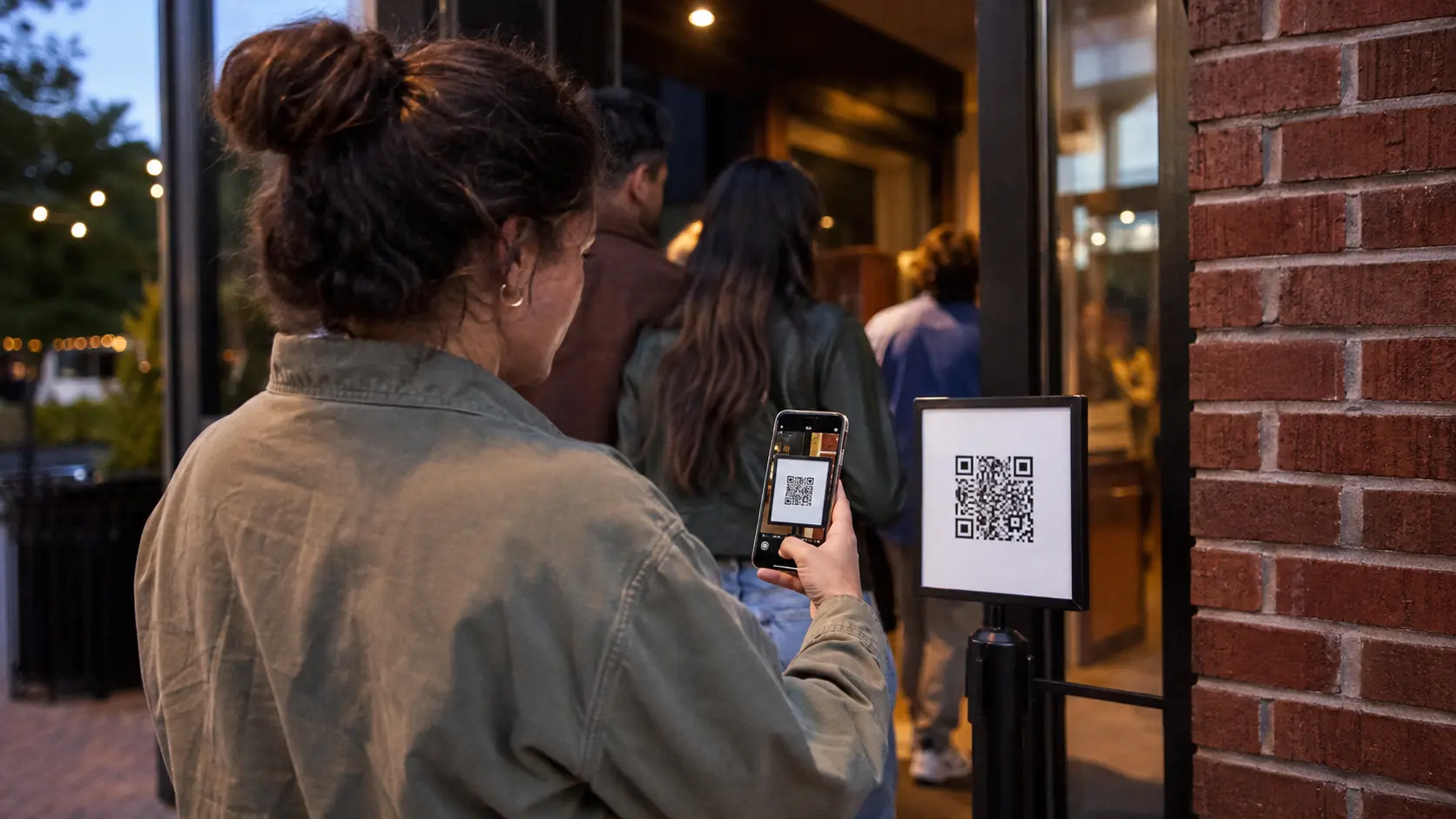
It works on the part the research says matters. Someone arrives at a physical place, scans a QR code, and gets something for it.
That produces two things at once. A record that this person showed up here, and a reason for them to come back, which is the recurrence the study identified as decisive.
The honest limit: this does not create discussion. If your members want a place to talk between gatherings, you still need a forum, and VISU sits alongside it rather than replacing it.
One thing we will not claim. There is no credible published research linking QR mechanics to retention, only vendor marketing without method. The argument here rests on the peer-reviewed findings about attendance and recurrence, not on scan statistics.
Give People a Reason to Come Back
Recurrence is the mechanism. A scan at the door, a reward for showing up, and a record that they did.
FAQ: Community Apps
What is a community app?
Software that gives a group its own space to talk, share content and organize gatherings, usually with member profiles, a feed or forum, and events. It differs from a social network because the group is closed and whoever runs it sets the rules. It differs from membership management software because the focus is interaction rather than billing and records.
What is the best free community app?
Discord and Facebook Groups are the most used free options. Slack has a free tier with unlimited members but limited history, and Discourse is fully open source and free if you host it yourself. The cost of free is that on Discord and Facebook you control neither the data nor the relationship with the member. Discourse is the only genuinely free option that preserves data ownership.
How much does a community app cost?
Published pricing runs from 9 dollars monthly on Skool Hobby, which carries a 10 percent transaction fee, to 99 on Skool Pro, 40 to 49 on Heartbeat, 79 on Mighty Networks, 89 on Circle, 100 for hosted Discourse and 399 on Bettermode. Hivebrite, Circle Plus and Bettermode Premium are quote only. Watch the real cost, which is subscription plus transaction fee plus per-seat add-ons for admins and moderators.
Do I need a community app if my group already meets in person?
It depends what you are solving. If the problem is conversation between gatherings, yes. If the problem is getting people to show up and come back, the research suggests a forum does not solve it. A study of 1,551 participants published in Social Psychological and Personality Science in 2025 found social connection came from active, in-person participation in recurring events, and that the effect did not hold 24 hours later. That makes recurrence the deciding factor.
Why is my community inactive?
Because participation inequality is structural rather than a mistake you made. The 90-9-1 principle described by Jakob Nielsen holds that 90 percent of members read without contributing, 9 percent contribute occasionally and 1 percent generate nearly all content. On Wikipedia, 99 percent only read. Even Nextdoor, with more than a hundred million verified neighbors, reported 21 million weekly actives in late 2025, down 5 percent year over year. Counting posts measures the wrong thing when a community belongs to a place.
Is a community platform worth it for a local business?
Rarely on its own. Platforms built for organizations start at 399 dollars monthly and quote higher, while the cheapest creator plans take up to 10 percent of revenue. For a business whose community already gathers at a physical location, the harder problem is attendance and return rather than discussion, and a forum does not address it.