

The average person encounters somewhere between 6,000 and 10,000 commercial messages every single day. Most of them blur into background noise. People consciously notice fewer than 100. They engage with fewer than 10. They remember almost none of them. Welcome to the attention economy, where the most valuable resource in the world is also the most limited: focused human attention.
For marketers, this is not a theoretical shift. It determines which brands grow and which ones drown in an ocean of noise. Every campaign, every media plan, every creative concept is competing for the same finite pool of seconds and cognitive bandwidth. In this environment, it is no longer enough to be visible. You need to be chosen. Understanding that attention has real, measurable value is the first step toward building strategies that work.
The Attention Crisis is Real and Accelerating
The data tells a sobering story about the core challenge in modern marketing. Human attention spans for digital content have dropped from roughly 12 seconds in 2000 to about 8 seconds today, which is frequently compared to a goldfish for a reason. At the same time, the volume of information competing for that shrinking attention has grown exponentially.
Information overload is not an abstract concept. In practical terms, it means your campaign does not exist in a vacuum. It fights for relevance against notifications, chats, streaming platforms, email, social feeds, and thousands of other brand messages that users did not ask to see. The result is a permanent attention deficit environment.
The economic consequences are visible in almost every performance dashboard. Cost per impression has multiplied compared to a decade ago, while click through rates and organic reach curves slope downward across nearly all major platforms. A large share of internet users actively install tools to filter or block ads, and a clear majority say most advertising feels intrusive, repetitive, or irrelevant.
At the same time, marketing budgets keep increasing. Global ad spend exceeds hundreds of billions of dollars each year, yet consumer trust in advertising sits near historical lows. Customer acquisition costs have risen across almost every digital channel since 2019, especially in competitive categories like finance, ecommerce, and subscription services.
In other words, brands are paying more and more to access an audience that is paying less and less attention. This is the structural crisis at the heart of the attention economy. It forces marketers to shift from a mindset of reach at all costs to one of efficiency, respect, and measurable value.
This raises two uncomfortable but essential questions. If attention is the real currency of the digital world, why do so many strategies still treat it as if it were limitless and free? And what happens when users realize they can demand compensation for attention they have been giving away without reward for years?
Understanding the Attention Economy: Core Theory
The phrase "attention economy" is not a buzzword invented by adtech. It traces back to economist and Nobel laureate Herbert A. Simon, who wrote that "a wealth of information creates a poverty of attention." As information becomes abundant, attention becomes the bottleneck. Digital technology has only amplified this effect.
The internet removed distribution constraints. Any brand can publish content globally, instantly, at near zero marginal cost. Social networks then layered discovery and virality on top, encouraging everyone to publish constantly. The result is an almost infinite supply of content chasing a fixed and non scalable pool of attention. Scarcity moves from information to focus.
Why Attention Became Scarce
Four forces created the modern attention crunch for marketers:
- Information Explosion: Global data creation has multiplied many times over in a little more than a decade. For an individual user, this means news feeds that never end, infinite scroll interfaces, and an endless backlog of "watch later" or "read later" items that never get opened.
- Channel Proliferation: What used to be a handful of mass media outlets has fragmented into hundreds of channels and formats. Short form video, live streams, podcasts, newsletters, messaging apps, and communities all compete simultaneously for share of mind.
- Technology Acceleration: People check their phones dozens or even hundreds of times per day. Each check is a context switch that breaks deep focus. Notifications, badges, and alerts are constantly pulling micro slices of attention in different directions.
- Cognitive Limits: The human brain has not changed in step with technology. There is a ceiling to how many decisions, messages, and stimuli people can process in a day before they hit fatigue and start filtering aggressively.
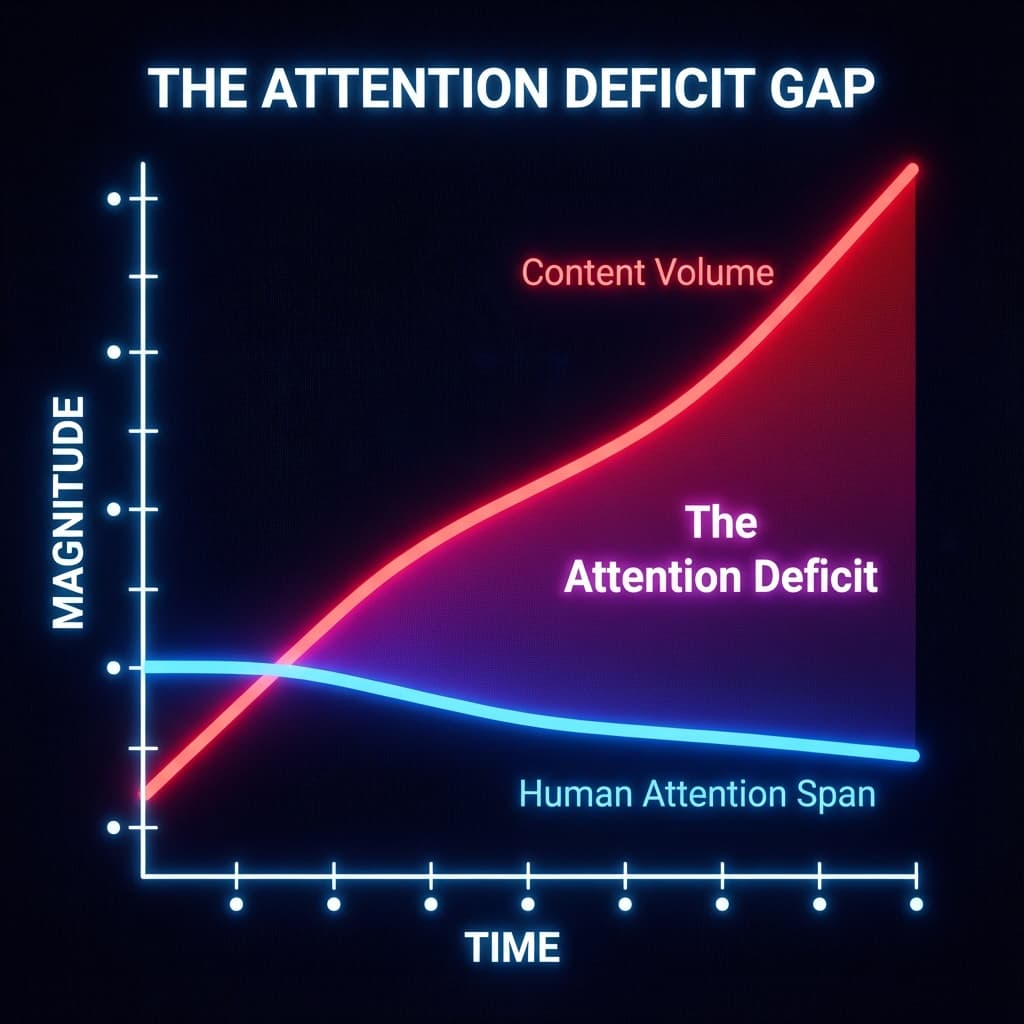
For marketers, this theory has a very practical implication. You are not just buying media. You are renting a slice of someone's finite cognitive capacity. If what you show them does not justify that cost, they will protect their attention with every tool available.
The Current Attention Landscape (2024 to 2025)
Shrinking Attention Windows
The famous "8 second attention span" statistic gets quoted frequently, but decision thresholds are even shorter in practice. On social platforms, users often decide in less than three seconds whether they will stay with a piece of content or scroll past it. That decision is based on a small set of visual and contextual signals: thumbnail, first line of copy, sound hook, and perceived relevance.
Different generations interact with content in different ways, which has direct implications for creative strategy and media planning.
| Generation | Avg. Content Focus | Primary Behavior |
|---|---|---|
| Gen Z | About 6 seconds | Rapid filtering, skip first, heavy short form video. |
| Millennials | Around 12 seconds | Dual screening, constant multitasking. |
| Gen X | Roughly 18 seconds | Task driven, research focused. |
| Boomers | 25 seconds or more | More linear consumption, fewer switches. |
Understanding these patterns matters because attention strategy is not "one size fits all." Gen Z might respond better to interactive, reward based formats that acknowledge their time explicitly. Decision makers in B2B contexts might prefer fewer interruptions but deeper, high value content when they do engage.
The Economics of Attention
The economic side of the attention landscape is equally important. Brand teams have watched media costs climb year after year while performance metrics stagnate or decline. Average CPMs on many major networks are significantly higher than they were in the mid 2010s. In certain categories, search and social auctions have turned into bidding wars.
Higher competition for the same eyeballs drives acquisition costs up. It also encourages aggressive optimization for short term metrics, which can erode trust and attention over the long term. For example, clickbait headlines may spike click through rates temporarily, but they teach users to distrust brand promises.
In this context, the brands that will win are the ones that treat attention as a long term asset instead of a disposable input. They design media investments to build durable relationships, not only instant conversions.
How Consumer Behavior is Evolving
Consumers have quietly developed their own defense systems against overload. They unsubscribe from newsletters that do not deliver value. They mute Instagram stories that feel repetitive. They move brand emails into folders they never open. They skip, scroll past, or ignore anything that signals low relevance.
From Passive to Active Attention Management
Ten years ago, many people simply accepted the digital environment as it appeared. Today, they are far more proactive about filtering. They curate feeds, block sources, and intentionally choose which platforms deserve their time. Attention is managed like a budget.
The Permission Economy
Permission is no longer a one time event like joining a list. It is a dynamic state. A user who followed your brand last year may be ignoring you today. Every new message is an opportunity to either confirm that permission or lose it. That is why the quality of each touchpoint matters more than the total volume.
Consumer insight: More and more people expect to receive something tangible in return for their time, whether that is practical value, status, entertainment, or direct rewards. "Free content" alone is no longer a differentiator.
Once you understand this behavior shift, the gap in many marketing strategies becomes obvious. They still use tactics built for a world where attention was passive and inexpensive, not one where users actively protect and allocate it.
New Frameworks for Attention Respectful Marketing
To navigate the attention economy effectively, marketers need operating frameworks that place attention at the center of their strategy instead of treating it as a byproduct.
Framework 1: The Attention Value Exchange
Every interaction can be framed as a value exchange. The user invests time and focus. The brand must provide something that feels worth that investment. If the perceived value is lower than the attention cost, the interaction is experienced as spam, regardless of how beautiful the design is.
- Attention cost: Time spent, cognitive effort, potential distraction from other tasks.
- Value delivered: Clarity, utility, emotional payoff, financial reward, or a combination.
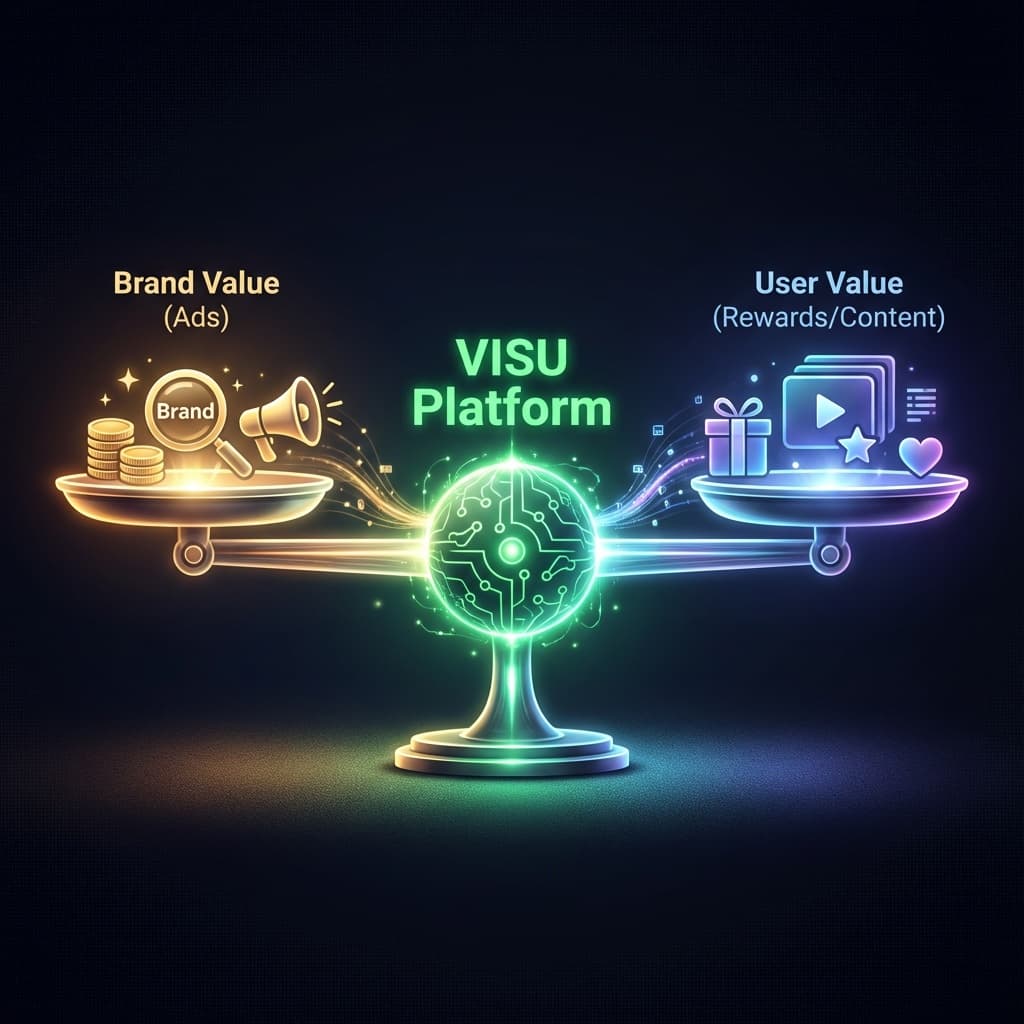
Applied to media planning, this means asking a different question. Instead of "What can we make people watch?", ask "What is worth watching for them, and how can we reward that choice?"
Framework 2: Bought, Earned, and Owned Attention
Modern strategies blend three attention sources:
Bought attention comes from paid media. It is fast but fragile. You get reach while you pay and lose it when the budget stops.
Earned attention comes from recommendations, PR, and shares. It has high trust but is unpredictable and hard to control.
Owned attention comes from channels where you have a direct relationship, such as apps, email lists, communities, and permission based messaging. It requires more effort to build but becomes a compounding asset over time.
A resilient brand in the attention economy uses paid to acquire, content and community to earn, and products like VISU to convert that attention into an owned, measurable network of engaged participants.
Framework 3: Attention ROI
Traditional ROI often looks at revenue against spend. Attention ROI looks at how much high quality attention you bought versus what you could have achieved with a different allocation.
Attention ROI = (High quality attention gained - Attention wasted) / Attention cost
In practice, this means prioritizing channels and formats that produce measurable engagement, opt ins, or rewarded participation instead of chasing low cost impressions that no one notices.
Measuring Attention: Beyond Clicks and Impressions
If your measurement system treats all impressions as equal, you are blind to the economics of attention. Measurement needs to distinguish between interrupted, glanced, and truly engaged attention.
The Problem with Legacy Metrics
- Impressions only confirm that an asset was served, not that it actually entered consciousness.
- Clicks can be accidental, driven by curiosity, or influenced by misleading creative.
- Time on page can be inflated by idle tabs or users who walked away from their device.
These metrics still have value, but they are insufficient on their own to make attention aware decisions.
New Attention Metrics
| Metric | Definition | Why It Matters |
|---|---|---|
| Active attention time | Seconds of observable, focused engagement with content. | Correlates with recall, uplift, and downstream action. |
| Engagement depth | Combination of scroll depth, interactions, and dwell time. | Helps separate skimmers from truly engaged users. |
| Permission events | Opt ins, app installs, profile completions. | Signal high intent and create owned attention assets. |
| Rewarded completion rate | Percentage of users who complete opt in tasks to earn rewards. | Shows how much users value the exchange you are offering. |
Platforms like VISU are designed around these modern metrics. Brands pay for verified actions, not for mere exposure. Users receive direct, transparent rewards. Creators and partners earn a share of the value generated by attention they help capture.
Platform Dynamics: The Attention Marketplace
Major digital platforms operate as marketplaces where attention is gathered, packaged, and auctioned to advertisers. The platforms themselves are the primary winners of this model, since they keep the majority of the economic value created by user attention.
The traditional model looks like this:
- Users receive "free" services and content.
- Platforms collect data and aggregate attention.
- Brands pay platforms to access that attention in the form of ad inventory.
This model created powerful targeting capabilities, but it also created dependency risks for brands. Small changes in algorithms, policies, or auction mechanics can radically impact performance without warning. It also removes users from the value chain, even though their attention is the asset being sold.
The emerging alternative: attention reward ecosystems. In these models, the economic loop changes. Users are not just a product. They are active participants who receive a defined share of the value that their attention generates. Brands still pay for access, but that payment is shared between platforms, participants, and in some cases creators or venue partners.
This is the paradigm VISU operates in. Brands fund campaigns that reward real world attention such as scanning a QR code, exploring an offer, or visiting a location. Users earn money or points for participating. Creators and partners who bring users into the ecosystem earn commission. Everyone in the chain understands what they receive for the attention they contribute.
The Ethics of Attention Capture
Attention is not just a marketing resource. It is a human one. How brands and platforms treat it has mental health, societal, and regulatory implications. Patterns like infinite scroll, autoplay, or streak mechanics can easily slide into exploitative territory if the goal is simply to maximize time spent at any cost.
Why Ethics is a Strategic Imperative
- Regulation is increasing: Privacy laws were a first wave. Expect future rules around addictive design, dark patterns, and digital well being.
- Reputation matters: Brands that are perceived as manipulative, spammy, or disrespectful face backlash, boycotts, and rapid loss of trust.
- Retention depends on respect: Even if you can force attention in the short term, people will eventually opt out if they feel exploited.
Strategic Insight
Ethical attention design is no longer just the right thing to do. It is a competitive advantage. When users feel that a brand values their time, they are far more willing to offer it in the future.
For marketing teams, this means asking a simple but powerful question: "If I were the user, would I feel respected by this experience?" If the honest answer is no, then the execution is putting both brand and long term attention capital at risk.
Emerging Solutions and Innovations
The pressure of the attention economy is driving a new wave of tools and models that reshape the relationship between brands, platforms, and people.
Solution 1: Attention Rewards Platforms
In attention reward ecosystems, users are not passive recipients of ads. They choose to participate in campaigns and receive direct compensation for doing so. This creates three critical advantages:
- Every impression is voluntary: Users opt in to experiences because they are curious, motivated by rewards, or both. There is no need to trick them into watching.
- Engagement is deeper: When people know they are earning something, they are more likely to pay attention, complete steps, and remember what they have seen.
- Measurement is cleaner: Brands can see exactly who engaged, what they did, and what value was created, without depending on third party cookies or opaque algorithms.
VISU is part of this new category. By connecting smart QR codes, real world locations, and gamified missions, VISU turns attention into a measurable asset. Brands pay for scans, visits, or actions. Users receive rewards for participation. Creators and partners share in campaign value. Instead of buying abstract reach, marketers invest in verified interactions.
Solution 2: Privacy First Advertising
As tracking becomes more restricted, the industry is shifting from surveillance based targeting to respect based targeting. Contextual advertising, high quality creative, and transparent value exchanges become more important than individual level behavioral profiles.
When you design a campaign that is clearly valuable to the user, you need less invasive data to make it work. The most effective message in the attention economy is often the simplest: "If you give us a few seconds, here is what you get in return."

Practical Implementation Guide: 12 Month Roadmap
Translating attention theory into execution requires a structured plan. The following roadmap provides a practical starting point for brands that want to compete more effectively in the attention economy.
| Phase | Key Actions | Success Metric |
|---|---|---|
| Months 1 to 3 (Audit and Foundation) | Map all channels where you currently buy or earn attention. Identify where you are paying for impressions that receive almost no engagement. Introduce basic attention metrics like active time and depth. | Reduction in low quality impressions and wasted spend. |
| Months 4 to 6 (Experiment and Learn) | Launch pilots that test attention reward formats, interactive experiences, or VISU powered campaigns. Compare them against traditional ads on both cost and engagement quality. | Higher engagement depth and opt in rates on experimental formats. |
| Months 7 to 12 (Scale and Systematize) | Shift budget from low attention channels toward those that deliver measurable, high value engagement. Build more owned attention assets such as apps, communities, or VISU based missions that users choose to join. | Improved lifetime value and retention, reduction in customer acquisition cost. |
This roadmap does not require abandoning your current media mix overnight. It starts with visibility, then small tests, then gradual reallocation toward strategies that treat attention as an asset to be earned and rewarded.
The Future of Attention (2026 to 2030)
The next few years will likely deepen, not resolve, the attention challenge. Content creation will continue to accelerate. New devices and interfaces will appear. AI generated media will multiply the amount of material competing for every second of human focus.
At the same time, three structural shifts will create new opportunities for brands that adapt early:
- Attention as an explicit asset: People will better understand the value of their attention and demand clearer terms for how it is used. Platforms that reward users and give them control will gain an advantage.
- Hyper personalization without creepiness: AI will make it possible to produce highly relevant creative for each individual while still respecting privacy, especially in environments where users have opted in.
- Regulation of addictive patterns: Governments and industry bodies are likely to intervene more directly when design choices harm well being. Ethical approaches will move from "nice to have" to mandatory.
All of these shifts point in the same direction. The market will increasingly favor brands that treat attention as borrowed, not owned. The winners will be those who prove, with every interaction, that they deserve the time they are asking for.
Conclusion: The Strategic Choice
The attention economy is not an external trend that you can choose to ignore. It is the environment in which all modern marketing operates. You can either design for it or be shaped by it.
To design for it, you need to accept a simple premise: attention has a cost. When you respect that cost, you start to build value exchanges that work for everyone involved. That might mean shorter, clearer creative. It might mean interactive formats that fit directly into user journeys. It might mean reward based campaigns powered by platforms like VISU that pay users for the attention they give.
The brands that thrive in the next phase of digital marketing will be the ones that shift from extraction to partnership. They will not ask "How do we get more of their attention?" but "How do we make our use of their attention worth it for them?" When that question sits at the center of your strategy, the metrics that matter most start to move in the right direction.
Stop Paying for Ignored Impressions
Join the brands that are using VISU to capture guaranteed, high quality attention instead of buying empty reach. Pay only for verified engagement and build a network of users and partners who are rewarded for participating.Frequently Asked Questions
What is the Attention Economy?
The Attention Economy is a way of understanding markets where human attention is the scarce resource. Information and content are abundant, but there is a hard limit on how much people can process. Brands compete to earn focused attention and turn it into measurable business outcomes.
How can brands survive ad fatigue?
Brands survive and grow by shifting from interruption to value exchange. That means designing content and campaigns that offer something clear in return for attention, such as practical insights, entertainment, or direct rewards through platforms like VISU. Respect for the user's time is the baseline.
Is attention based marketing ethical?
Attention based marketing can be ethical if it is built on consent, transparency, and fair value. It becomes unethical when it uses dark patterns, manipulates vulnerabilities, or intentionally maximizes addiction. Ethical approaches treat users as partners and give them more control over how their attention is used.
What metrics should replace impressions and clicks?
Impressions and clicks can still be useful, but they should be complemented with attention aware metrics such as active attention time, engagement depth, permission events, and rewarded completion rates. These metrics focus on quality of attention instead of only quantity of exposure.