

Since the pandemic normalized contactless interactions, QR codes have shifted from stopgap to strategy. In 2026, the question is no longer "Should we use QR codes?" but "Which platform compounds our results?" Your choice impacts analytics depth, engagement after the scan, integration workload, and total cost of ownership. The wrong platform locks you into pricey tiers and shallow data. The right one converts scans into relationships, referrals, and revenue loops. This guide compares the leading platforms, analyzes features and pricing, and shows how to choose the best option for your business QR code strategy following industry best practices.
Why Platform Choice Matters
QR codes seem simple: a square that leads to a link. But the difference between platforms lies in what happens after the scan. Basic platforms answer "how many scanned?" Advanced platforms answer "what did they do next, who did they refer, and how much revenue did they generate?"
According to Grand View Research, the global QR code market is expected to grow at double-digit rates through 2030, driven by payments, marketing, and phygital experiences. Companies that choose platforms with limited vision fall behind when they need to scale campaigns or prove ROI.
The decision also affects hidden costs. Platforms that seem cheap often require add-ons for essential features like advanced analytics, CRM integrations, or unlimited dynamic codes. Total cost of ownership can triple when you add up all the pieces.
The Biggest Players and Where They Fit
The QR code platform market includes everything from basic free tools to complete enterprise solutions. Each has clear strengths and limitations.
Bitly: Brand Recognition Meets Premium Pricing
Bitly expanded from link shortening to QR generation, winning market share through years of built trust and solid enterprise integrations with CRMs and automation tools like HubSpot, Salesforce, and Zapier. The free tier is deliberately limited with no dynamic codes and minimal tracking. Mid-tier plans starting around $29 per month still limit advanced features, while true enterprise capabilities can climb into four figures monthly. You're paying for resilient infrastructure and a familiar brand that makes procurement approvals easier. But QR-specific innovation isn't Bitly's core focus.
Best fit: Organizations already deep in Bitly's link stack that prioritize standardization and familiarity over novel engagement models.
QR Code Generator PRO: Visual Customization with Implementation Friction
Known for rich branding options including logos, frames, colors, and custom formats, QR Code Generator appeals to design-led teams and agencies needing strict visual control. Analytics cover device, location, and scan time. The trade-off is steeper setup and feature bundles that often push upgrades when you need advanced analytics but inherit complex user management and permission requirements. The product monitors scans competently but offers few tools to extend engagement or reward behaviors post-scan.
Best fit: Brand-conscious teams with bandwidth for admin setup who need volume generation and strict visual control but don't depend on post-scan engagement.
Brave Browser: Zero-Friction QR, Minimal Campaign Depth
Brave's native QR creation lowers friction for one-off sharing. Privacy-first analytics are a plus for users who value that aspect. But there's no dynamic routing, no campaign manager, and limited measurement. Brave works for personal or ad-hoc use but is insufficient for marketing programs requiring iteration, A/B tests, or multi-location reporting.
Best fit: Individual sharing or simple link distribution without business analytics, structured campaigns, or lifecycle engagement needs.
VISU: Engagement Engine Beyond the Scan
VISU treats the QR code not as a bridge but as an engine. The platform was built to transform scans into compounding engagement loops through tokenized rewards, multi-layer referrals, and revenue sharing. Analytics go beyond counts: multi-layer attribution tracks share cascades, repeat actions, and downstream revenue. Heat maps show performance by physical placement. Funnels expose drop-offs between scan, click, action, and share. Integrations focus on commerce: POS, e-commerce, and loyalty systems that close the loop between QR intent and actual revenue. Anti-fraud protections include rate limiting, anomaly flags, and geo incongruence checks.
Best fit: Companies that want to transform QR codes into acquisition and retention channels with measurable ROI, especially retail, restaurants, events, and referral programs.
Feature-by-Feature Comparison
To simplify evaluation, we've organized the main differences into functional categories.
Analytics and Tracking
Legacy platforms answer "who scanned and when?" with totals, uniques, device mix, geography, and time series. Useful information but limited to the moment of scanning. VISU extends visibility to "what happened next?" by tracking multi-layer referrals, share cascades, repeat actions, and revenue attributed to each code and each layer of the referral tree. Heat maps reveal placement performance across menus, doors, tables, and flyers. Funnels expose exactly where users drop off between scan, click, action, and share, enabling surgical optimization.
Campaign Management
Bitly keeps dynamic codes inside link ops, which feels familiar if you already manage shortened links. But it can get cluttered with large QR programs that have their own logic. QR Code Generator uses folders and hierarchies for organization at scale, requiring upfront taxonomy and admin discipline that not all teams can maintain. VISU models campaigns around incentives and referral trees, with dashboards that highlight which rewards and placements drive participation—not just scans, but conversions and multiplication.
Integrations and API Focus
Bitly offers turnkey connectors for HubSpot, Salesforce, Zapier, and other automation tools, making it strong for standard marketing data integration. QR Code Generator has a solid API but fewer out-of-the-box connectors, often requiring dev time for custom integrations. VISU takes a commerce-first approach with POS, e-commerce, and loyalty system integrations that close the loop between QR intent and actual revenue or rewards. Webhooks and API allow syncing with CRM and BI tools.
Security, Compliance, and Governance
All vendors cover basics: HTTPS, role permissions, and enterprise SKUs with SSO, audit logs, and retention controls. VISU adds protections specific to rewards economics: per-user rate limiting, behavioral anomaly flags, geo incongruence checks, and device patterns. These controls don't exist in simple scan trackers because they don't have token economics to protect.
Pricing Models
Pricing structures change frequently. Treat this comparison as directional and verify current vendor pages for exact quotas and terms before deciding.
| Feature | Bitly Free | Bitly Mid (~$29) | QR Gen Basic (~$12) | QR Gen Pro ($50+) | VISU Starter ($19) | VISU Growth ($49) |
|---|---|---|---|---|---|---|
| Dynamic Codes | No | ~50 | ~5 | Unlimited | Unlimited | Unlimited |
| Custom Branding | No | Limited | Yes | Yes | Yes | Yes |
| Advanced Analytics | No | Limited | Basic | Yes | Yes | Yes |
| API Access | No | Limited | No | Yes | Yes | Yes |
| Rewards / Gamification | No | No | No | No | Yes | Yes |
| Revenue Sharing | No | No | No | No | No | Yes |
| Referral Tracking | No | Basic | No | No | Multi-layer | Multi-layer |
Turn Every Scan Into Measurable Outcomes
Launch QR journeys with attribution, rewards, and referrals—not just redirects.
From Scan to Share: Rewards and Engagement
Legacy platforms treat a QR code like a bridge: user scans, arrives at destination, end of story. VISU treats it like an engine: each scan can trigger new scans, orders, and shares. With tokenized rewards and multi-layer referrals, you can set incentive tiers. For example: 10 tokens for a scan, 100 for a first purchase, 100 for each referral order. Tokens can be directed toward discounts, exclusive perks, or payouts.
This transforms a static redirect into a compounding engagement loop. Each user has an incentive to bring more users. Each code generates data about its individual performance and about the network it catalyzes. Revenue sharing lets you compensate QR owners, partner venues, and content creators based on attributed outcomes—not upfront fees. Referral trees attribute downstream engagement up to multiple layers so you can see exactly where networks form and who the multipliers are. Anti-fraud controls including velocity checks, anomaly detection, and geo incongruence flags maintain reward integrity throughout your program.
Practical Scenarios Across Verticals
Platform choice depends on what you need to accomplish. Below are specific use cases by segment.
Restaurants and Hospitality
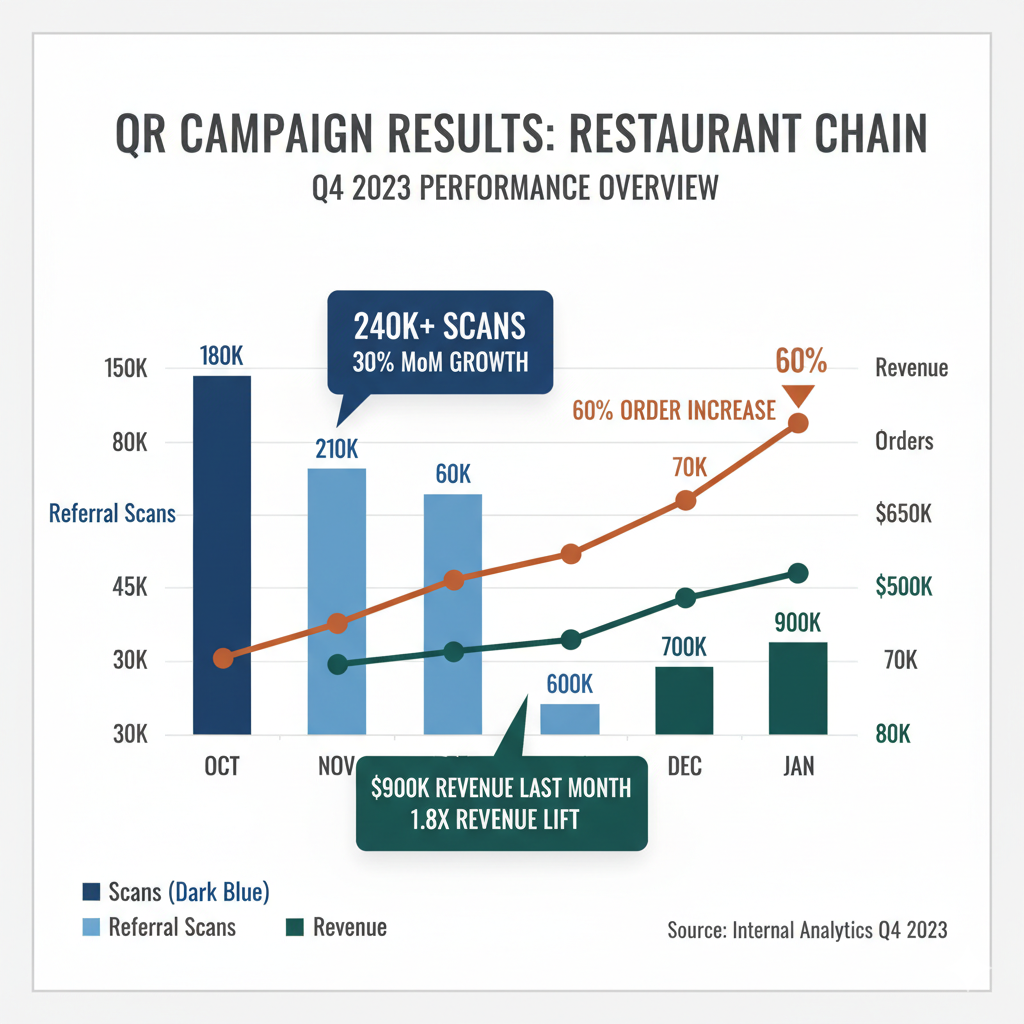
A 12-location fast-casual chain deployed location-specific codes on table tents and receipts. Rewards boosted first orders while referrals drove second-order growth. Results over 90 days: 8,400 total scans, 2,100 attributed first orders, 3,800 referral scans, 1,200 converted referral orders, approximately $94k in attributed revenue, and around $8.2k in distributed rewards. Net ROI of approximately 340%. To replicate this visibility with Bitly or QR Code Generator, you'd need to contract a separate loyalty platform and build custom referral tracking—significantly increasing cost and complexity.
Retail and CPG
Packaging QR codes unlock setup guides, tutorial videos, and referral rewards for social shares. VISU's heat maps identify which stores and shelves have the highest downstream influence, informing merchandising and co-op spend decisions with data beyond simple scan counts. Multi-layer attribution lets you see not just how many scanned, but how many bought, how many referred friends, and how much revenue each physical placement generated downstream.
Events and Venues
For conferences, concerts, and trade shows, a single code can orchestrate registration perks, sponsor offers, and post-event follow-ups. Referral trees reveal which sessions, booths, or signage placements generated the most secondary engagement. This data guides next-event layout and sponsorship pricing based on actual performance, not estimates.
Influencers and Creators
Replace generic link-in-bio QR codes with revenue sharing tied to verified conversions. Multi-layer referrals expose the micro-networks catalyzed by each creator—valuable information for co-marketing deals and fair payouts based on actual results.
Migrating Without Friction
One of the biggest concerns when switching platforms is already-printed physical materials. Dynamic codes solve this: you can redirect existing prints to VISU destinations without reprinting. The migration process includes importing historical campaign links, mapping existing UTMs, and maintaining analytics continuity. VISU's API and webhooks sync data with your CRM or BI tools, while POS and e-commerce connectors close the revenue loop.
Objections You'll Hear and How to Address Them
"We already use Bitly." You don't need to abandon it. Keep Bitly for general link shortening and point high-impact campaign QR codes to VISU. You get deeper attribution, rewards, and referrals without ripping out your existing stack.
"We need strict brand control." VISU supports custom frames, full color control, center logos, and white-label options for partner programs. Visual control is on par with QR Code Generator.
"Referral fraud worries us." Anti-abuse protections are native to the platform: per-user velocity caps, geo mismatch flags, device patterns, and configurable campaign rules. Token economics stay protected from day one.
"We don't have time for complex migration." Dynamic codes mean migration is a URL redirect, not material reprinting. Guided onboarding helps configure first campaigns in hours, not weeks.
Capability Matrix: Visual Summary
For quick reference, the table below summarizes each platform's main capabilities.
| Capability | Bitly | QR Code Generator | Brave | VISU |
|---|---|---|---|---|
| Dynamic Routing | Yes (tiered) | Yes | No | Yes |
| Scan Analytics | Yes | Yes | Limited | Yes |
| Post-Scan Engagement Analytics | No | No | No | Yes (multi-layer) |
| Rewards / Gamification | No | No | No | Yes (tokens) |
| Revenue Sharing | No | No | No | Yes |
| POS / Loyalty Focus | General | General | N/A | Deep |
| Onboarding Complexity | Low–Medium | Medium–High | Low | Low–Medium |
| Cost to Replicate VISU | High (add-ons) | High (add-ons) | Not feasible | Bundled |
Bitly and QR Code Generator excel at traditional QR tracking. VISU adds the missing engines—rewards, multi-layer referrals, and revenue sharing—that transform scans into durable growth loops with measurable ROI.
Ready to Compound Results From Every Scan?
Run rewards, referrals, and attribution in one place—and prove ROI beyond simple scan counts.