

QR codes are everywhere: menus, packaging, event materials, retail displays. Yet most of the time, they're just shortcuts to static websites. That's a missed opportunity.
The real potential? QR codes can become dynamic revenue channels that engage customers, generate income for businesses, and reward users for participating. All at once.
This represents a fundamental shift in digital advertising, moving from extraction to reciprocal value exchange. Understanding how gamification principles drive this transformation helps explain why monetized QR codes outperform traditional advertising channels.
Get Paid to Scan QR Codes
Turn your attention into real rewards. Scan, engage, earn.
Quick video. Earn your first reward.
The Crisis in Traditional Digital Advertising

Traditional advertising is breaking. Not slowly. It's actively falling apart.
Understanding the attention economy helps explain why. Global ad spending hit USD 1.1 trillion in 2024. Mobile ads alone are projected to reach USD 447 billion in 2025, more than half of all digital spend. For small and mid-sized businesses, competing on major platforms is economically impossible.
Consumer resistance makes it worse. Research shows 91% of people find digital ads increasingly intrusive. 79% feel tracked by targeted advertising. And 40% say the ads they see are irrelevant anyway. That's a trust gap you can't bridge by spending more.
Beyond the numbers, display advertising simply doesn't work anymore. People have learned to ignore banners, skip videos, and mentally filter out interruption-based marketing. This learned avoidance makes traditional channels less effective every year.
The fundamental problem? Brands need direct, efficient ways to connect with people instead of paying expensive intermediaries with declining returns.
How QR Codes Solve This Problem
Accessibility removes barriers. Any smartphone user can participate instantly. No app downloads. No complex flows. Point, scan, engage.
Contextual timing changes everything. Customers interact at precisely the moment and location where they're most receptive. Reading a menu, browsing a product, attending an event. This alignment between context and openness dramatically increases engagement compared to interruption-based ads.
The power of micro-rewards amplifies this further. Providing immediate value for attention transforms the relationship from extraction to exchange.
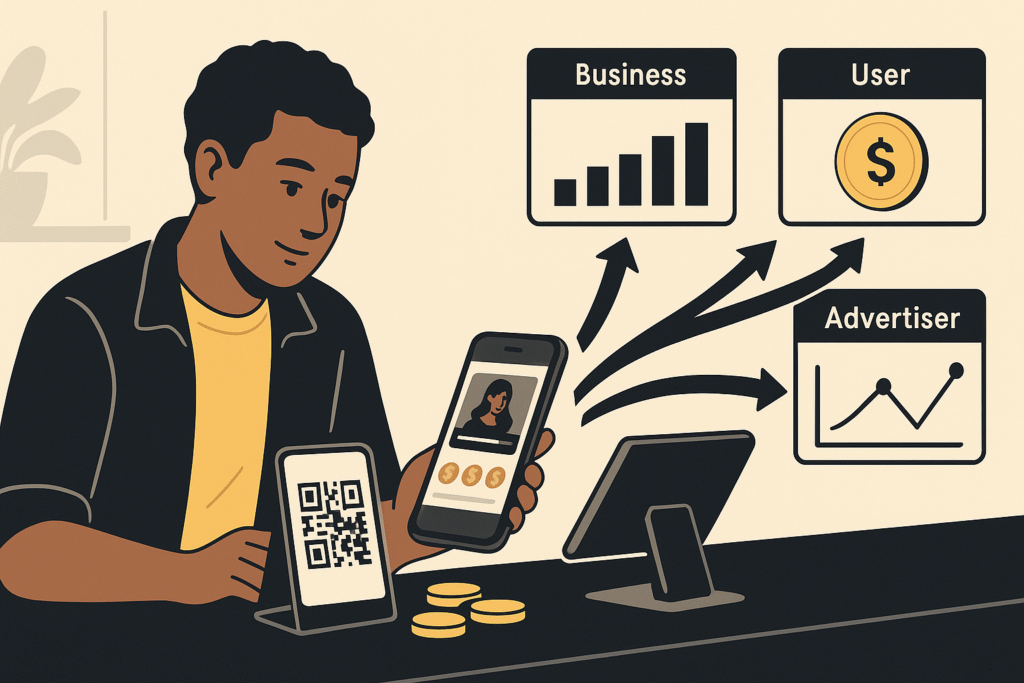
Revenue reversal transforms economics. Instead of being purely a cost center, advertising becomes a revenue source for businesses, delivers tangible rewards for users, and generates transparent metrics for advertisers. All three parties benefit simultaneously.
The shift: QR codes move advertising from extraction to reciprocal value exchange. Everyone wins or it doesn't work.
The Mechanics: How Monetized QR Codes Work
The user experience is simple but powerful. Understanding the difference between dynamic and static QR codes is essential for effective monetization.
Step one: A customer scans a QR code in a café, store, event venue, or on product packaging.
Step two: Instead of opening a static link, the code triggers a brief, personalized experience. Maybe a short video ad, maybe an interactive offer. Tailored to context and user.
Step three: Ad revenue automatically splits three ways. The business displaying the code gets a cut for providing the engagement platform. The user earns instant rewards like discounts, loyalty points, digital tokens, or exclusive content. The advertiser gets transparent engagement data and conversion metrics unavailable through traditional channels.
This three-way value split fundamentally differs from traditional advertising's zero-sum dynamics. It's not about extracting attention. It's about earning it.
Ready to Innovate Your Customer Experience?
See how businesses use VISU to turn QR scans into measurable engagement.
Why This Model Outperforms Traditional Channels
For businesses: A new revenue stream emerges without additional operational effort. Existing customer touchpoints become monetized assets. The relationship with customers strengthens because the experience delivers genuine mutual benefit.
For users: Advertising transforms from intrusive interruption into voluntary exchange. Rather than enduring ads passively, customers choose to engage and receive tangible rewards. This autonomy and reciprocity build trust and positive brand associations.
For advertisers: ROI substantially exceeds traditional channels because attention is earned, not interrupted. Customers who voluntarily scan represent a fundamentally higher-quality audience than passive viewers of display ads. The data collected is first-party, privacy-conscious, and directly actionable.
The Market Validates This Approach
The momentum behind monetized QR models reflects broader market recognition that traditional advertising is failing.
Digital ad costs keep climbing, making organic audience growth increasingly valuable. Consumer resistance to intrusive advertising intensifies annually, pushing marketers toward permission-based models. Competition for attention grows fiercer while effectiveness declines.
Meanwhile, QR code scanning has become habitual for millions of consumers. The accessibility question is settled. It's now a prerequisite for participation in modern commerce.
Implementation: Getting Started
First, identify your objective. Are you seeking new revenue streams, stronger customer loyalty, or brand engagement? Clarity here shapes every subsequent decision. Reviewing QR code gamification strategies provides a framework for designing effective campaigns.
Second, design compelling incentives. Rewards need to feel substantial relative to user effort. A 10% discount might work for retail. A free drink might drive café engagement. The key is making participation feel genuinely worthwhile.
Third, create engaging content. Brief video ads or interactive experiences outperform static content. Personalization based on location or user preference dramatically increases completion rates and reward claims.
Fourth, place strategically. QR code placement matters enormously. Codes on receipts reach recent customers. Codes on packaging reach broader audiences. Codes on in-store displays target engaged shoppers. Multiple placements maximize reach and frequency.
Fifth, track and optimize. Monitor engagement metrics that actually matter like scan rates, content completion, reward claims, and conversion to purchase. Identify what drives superior performance, then scale what works.
Sixth, build community. Encourage referrals by rewarding users who share campaigns with friends. This creates organic growth momentum and extends reach beyond direct scanning.
Addressing Common Concerns
"Will people still skip ads?" Unlike traditional ads where skipping is encouraged, monetized QR models make skipping financially irrational for users. They chose to scan. They're getting paid to engage. The voluntary nature already filters for willing participants.
"Is implementation complex or expensive?" Modern platforms handle the technical infrastructure. Your investment involves campaign design and reward fulfillment. Most businesses launch pilots with minimal upfront cost.
"Will users actually engage repeatedly?" Yes, if rewards feel substantial and content stays fresh. The combination of utility and reciprocal value creates habit formation that interruption-based advertising can't match.
"What about privacy?" Monetized QR models collect first-party data directly from willing participants. Transparency about data use builds trust rather than eroding it. This is the inverse of tracked ad experiences.
The Broader Shift: From Extraction to Reciprocity
This transition reflects a deeper cultural change.
Consumers increasingly reject extractive models where their attention is harvested without compensation. They expect fair value exchange. They value autonomy over manipulation. They trust transparency more than algorithmic optimization.
Brands that recognize this shift and adapt their engagement models will build stronger customer relationships, generate more sustainable revenue, and develop competitive advantages that outlast individual campaigns.
Final Thoughts
Monetizing QR codes isn't just technological innovation. It's a cultural realignment in how we understand digital value and advertising ethics.
Traditional ad models are breaking down. Consumer resistance is intensifying. Cost structures are becoming unsustainable. Meanwhile, QR codes offer engagement that serves all participants fairly.
The future of marketing lies in everyday interactions. QR codes are the gateway to turning those moments into shared value.
Early adopters will build stronger customer relationships, capture new revenue streams, and stand out in an increasingly competitive market. The question isn't whether this model scales because the market is already proving it does. The question is how quickly your business will adapt.
FAQ: Monetizing QR Codes in Digital Marketing
How is monetizing QR codes different from traditional digital ads?
Do I need heavy foot traffic for this to work?
Who pays for the rewards users receive?
Which businesses benefit most?
Are monetized QR codes compatible with privacy regulations?
How quickly can I start seeing revenue?
Can I integrate with my loyalty program?
What content formats work best?
Transform Every Scan Into Revenue
Join businesses already using VISU for gamified QR experiences.