

Two years ago, most QR codes were glorified URL shortcuts. Scan, land on a website, done. That's changed dramatically.
In 2026, the brands getting real results from QR codes are doing something different. They're treating each scan as a conversation starter, not a dead end. They're compensating attention instead of demanding it for free. And they're collecting data that people actually want to share because the exchange feels fair.
This shift ties directly into how the attention economy has reshaped consumer expectations. People know their engagement has value. The brands acknowledging that reality are winning. Those still expecting free scans are watching their codes gather dust.
What follows is a practical look at what's working now, what's emerging, and what you can safely ignore for another year. If you're already running QR code marketing campaigns, this will help you level up. If you're just starting, it'll save you from chasing trends that don't matter yet.
Get Paid to Scan QR Codes
Turn your attention into real rewards. Scan, engage, earn.
Quick video. Earn your first reward.
Ten Trends Worth Knowing
Some of these are ready to implement today. Others are worth watching but not worth betting on yet. I'll be clear about which is which.
1. AI personalization that actually works
Not the "Hi [FIRST_NAME]" kind of personalization. Real-time decision making based on context.
When someone scans your code at 7am near a train station, they get one experience. Same code, same person, 6pm on a Saturday at a shopping mall? Completely different offer. The AI evaluates dozens of signals instantly and routes to whatever makes sense for that specific moment.
This used to require enterprise budgets and custom development. Now mid-market brands are running these campaigns on platforms that handle the complexity for them. The barrier dropped significantly in the last 18 months.
2. AR without the app store detour
WebAR finally matured. Scan a furniture tag, see the couch in your living room. No download required. The experience just works in the browser.
The caveat: older phones struggle. You need graceful fallbacks or you'll frustrate a chunk of your audience. Build for the best case, plan for the worst.
3. Rewarding attention instead of expecting it free
This is probably the most important shift happening right now.
Old model: put up a QR code, hope people scan, get annoyed when they don't. New model: offer something valuable in exchange for their time. Micro-rewards like loyalty points, small discounts, or exclusive access.
The performance gap is staggering. Rewarded scans hit 15-28% engagement. Unrewarded? You're lucky to crack 5%. That's not an incremental improvement. That's a completely different game.
4. Voice-activated QR experiences
Interesting but niche. Makes sense when hands are busy: cooking, exercising, driving. For most use cases, file under "check back in 2027."
If you're in food, fitness, or automotive, maybe worth a pilot. Everyone else can wait.
5. Blockchain verification
Luxury brands and pharma companies are all over this. Scan, confirm authenticity, trace the entire supply chain journey.
If counterfeiting costs you money or trust, the tech is ready. If not, it's probably overkill for now.
6. Gen Z scans differently than Boomers
Obvious when you say it out loud, but most campaigns ignore it completely.
Younger users want speed and gamification. They'll bounce instantly if things feel slow or corporate. Older users want clarity and utility. They'll engage deeply if you don't overwhelm them.
Smart campaigns use device signals and behavioral patterns to serve different experiences from identical physical codes. No awkward "select your age group" screens required.
7. Privacy transparency increases participation
Counterintuitive but true. When you explain clearly what you're collecting and why, more people opt in. Not fewer.
The sneaky data grabs are what create resistance. Honest exchanges build trust. Trust reduces friction. Friction kills conversions.
8. Multi-step journeys that compound value
Single-scan campaigns leave money on the table.
Multi-step flows work like this: First scan, create a profile, earn $0.50. Take a quick quiz, add $2. Watch some content, another $3. Complete a purchase, unlock $15. Total value to customer: $20.50 across four touchpoints.
Total value to brand: verified identity, stated preferences, demonstrated engagement, completed transaction. Both sides win, and the relationship deepens with each interaction.
9. Wearables and look-to-scan
Smart glasses that scan codes just by looking at them. Already happening in warehouses and factories. Consumer adoption? Still years away for mainstream use.
Monitor it. Don't plan around it.
10. Hyper-local context
Same QR code in a stadium serves different content based on which section you're sitting in. Same code in a mall adjusts offers based on nearby stores.
Add time-of-day logic and you can run morning campaigns that flip to evening experiences automatically. Weekday offers that switch to weekend mode. All from one printed code.
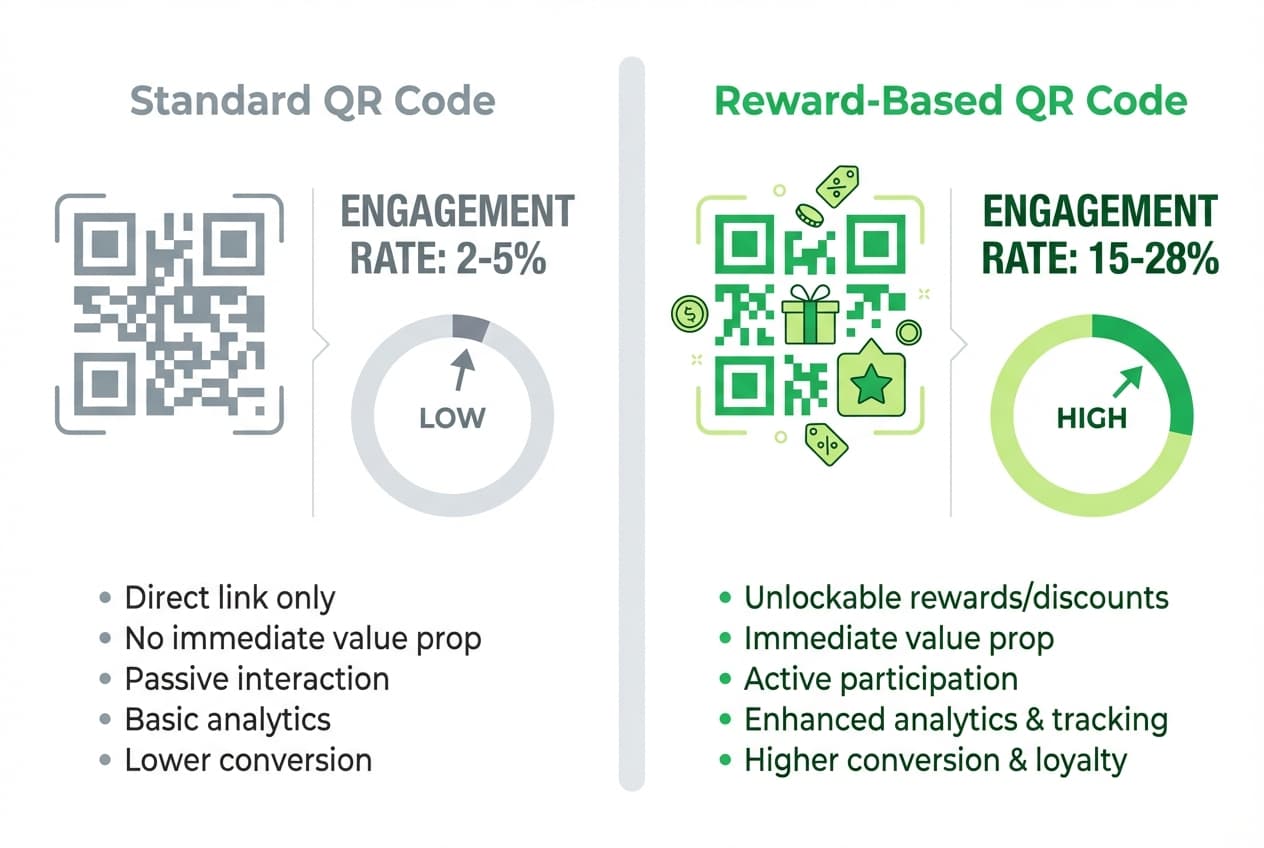
The Numbers: Standard vs Reward-Based
Here's where the theory becomes concrete.
Standard QR codes pointing to static pages: 2-5% scan rate from people who see them. Anonymous data. Limited actionability. You know someone scanned but not much else.
Reward-based campaigns: 15-30% scan rates. Verified first-party data with explicit consent. People telling you who they are and what they want because you gave them a reason to.
ROI difference: 3-8x on verified actions.
That multi-step journey I mentioned? $20.50 in rewards sounds expensive until you add up what you received. Verified identity. Preference data. Engagement proof. Completed purchase. Try buying all that from a billboard or banner ad.
The data quality improvement matters as much as the volume. Anonymous scan counts tell you about reach. Verified profiles with stated preferences enable personalization, retargeting, and lifetime value modeling. The gap between thin data and rich data shows up in every downstream metric.
Ready to Innovate Your Customer Experience?
See how businesses use VISU to turn QR scans into measurable engagement.
Putting This Into Practice
Don't try to implement ten trends at once. That's a recipe for half-finished projects and confused customers.
Start with an audit. Where do QR codes already exist in your business? Packaging, receipts, displays, ads? Which ones actually get scanned? Those high-performers are your laboratory.
First move: convert your top codes from static to dynamic. One change that lets you update destinations without reprinting anything. This unlocks everything else.
Second move: add rewards to your highest-traffic touchpoint. Measure before and after. The lift will tell you whether to expand or adjust.
Third move: introduce personalization rules based on the patterns you're seeing. Time of day, device type, location if you have it.
AR, voice, blockchain? Those come later, after the fundamentals perform consistently. Complexity without a solid foundation just creates expensive confusion.
One non-negotiable across all of this: the first scan must deliver value immediately. Seconds, not minutes. You can build elaborate journeys after you've earned trust. But that initial moment needs to be fast, rewarding, and friction-free. Lose them on scan one and you won't get a scan two.
Your 2026 Roadmap
Think in three chunks.
Now through Q1: Get reward mechanics working on your best touchpoints. Build privacy-first consent flows. Launch at least one multi-step campaign. These use mature capabilities and show results fast.
Q2 and Q3: Layer in AI personalization using behavioral data you've collected. Segment by generation based on device and timing patterns. Test geo-logic if you have physical locations. A/B test static versus dynamic experiences to quantify the difference.
Q4 and beyond: Explore AR for product visualization. Pilot voice if your category fits. Consider blockchain if authenticity matters in your space. Start small, validate acceptance, then scale what works.
Start Here
Want results this month? Here's the shortest path.
Find a high-traffic QR code you're already running without rewards. Move it to a platform that supports dynamic routing and attention compensation. Add a micro-reward. Something small is fine.
Measure for two weeks. Compare to baseline. You'll see the lift.
Once that's working, add personalization logic based on what the data reveals. Then expand to more touchpoints, optimizing each before scaling further.
The sequence matters. Nail the reward exchange first. Everything else builds on engaged users who trust you.
FAQ: QR Code Marketing Trends 2026
What actually changed about QR marketing?
How big is the performance gap between rewarded and standard codes?
What does AI actually do in these campaigns?
Won't asking for data turn people off?
Can smaller businesses afford this?
What's a multi-action flow?
Should I worry about AR and voice now?
How do I actually measure ROI?
Transform Every Scan Into Revenue
Join businesses already using VISU for gamified QR experiences.