

Loyalty programs used to be simple. Customers bought something, earned points, and redeemed a reward. That model still exists. But in 2026 it is no longer enough.
Customers today expect experiences, not just transactions. They want benefits that feel personalized, instant, and connected to how they actually shop. Both online and offline. As a result, customer loyalty programs have evolved into a diverse ecosystem with multiple models.
Brands now face a different challenge. The question is no longer whether to launch a loyalty program. It is which model to choose. Points, tiers, subscriptions, micro rewards, and gamified missions all drive engagement in unique ways.
Some models build long term retention. Others drive frequency. Some attract entirely new audiences to your customer base. Choosing the right one requires understanding how each type works and what behavior it encourages.
This guide compares the most important loyalty program types for 2026. Each section explains how the model works, who it is best for, and how it fits into modern loyalty strategies. You will also see how these programs connect with interactive experiences powered by VISU Solutions.
Points Based Customer Loyalty Programs
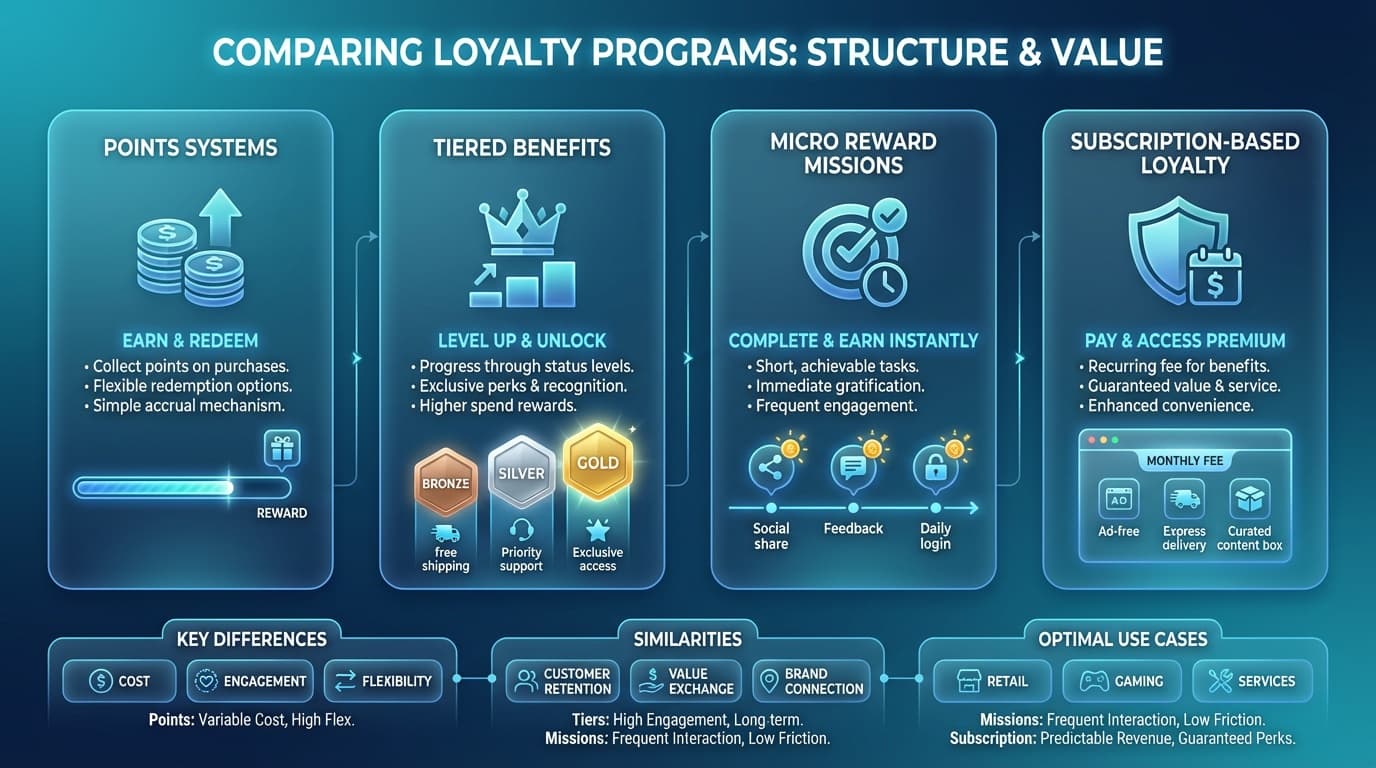
Points based programs are the classic model most brands start with. Customers earn points for each purchase or action. They redeem those points for discounts, products, or exclusive perks.
While simple, points systems have evolved significantly. In 2026, the most effective customer loyalty programs reward both transactional and behavioral actions. Not just spending.
Customers can earn points by scanning QR codes, joining missions, referring friends, or engaging with personalized content. This keeps your entire customer base active between purchases.
The strength of points programs comes from familiarity. Customers understand how they work without explanation. They also scale well across ecommerce and physical environments.
The weakness is that many points programs feel slow or generic. If the customer needs weeks to earn something meaningful, they lose interest. Unless the program includes instant wins or micro rewards.
Modern brands solve this by rewarding frequent micro actions. Tools like VISU QR Ads make every scan an event that grants small points or unlocks missions. This transforms points into an active part of the journey. For implementation details, see our QR code rewards program guide.
Points based loyalty still works extremely well in 2026. But only when combined with real time engagement and personalized incentives.
Best use cases for points programs
- Retail environments: Simple to implement across all product categories.
- Frequent purchase brands: Coffee, snacks, beauty products and essentials.
- Large SKU assortments: Points offset choice overload and encourage exploration.
- Omnichannel brands: Easy to merge ecommerce and in store journeys.
Points programs are reliable, flexible and familiar. They are easy to explain and easy to track. This makes them foundational to most loyalty strategies.
Tiered Customer Loyalty Programs
Tiered programs create a ladder of benefits. The more the customer participates, the higher they climb. Each higher tier unlocks better rewards. This motivates long term retention rather than quick wins.
In 2026, tiered loyalty remains one of the strongest models for brands that want VIP segments. It strengthens relationships with your most valuable customer base.
The challenge is that customers often feel stuck in lower levels. They lose interest if progress to a higher tier is too slow. This is where real time engagement helps.
When customers earn progress through actions like scanning QR codes, completing missions, or responding to prompts, progression feels dynamic. Moving to a higher tier becomes achievable and exciting.
Another advantage is emotional connection. Customers feel status as they move upward. This makes tiers especially effective for travel, lifestyle retail, fashion, and subscription services.
The best tiered programs combine transparent rules, visible progression, and incentives that upgrade the experience at each level. When done right, customers feel part of something exclusive.
Best use cases for tiered loyalty
- Fashion and lifestyle brands: Exclusive perks at each higher tier create prestige.
- Hospitality and travel: Customers stay loyal to climb the ladder.
- Gyms and wellness: Tier progression reinforces continuous participation.
- Membership based businesses: Tiers drive long term value and retention.
In 2026, tiered programs work best when they include micro incentives between tiers. This reduces drop off and encourages consistent engagement from your customer base.
Subscription Based Loyalty Programs
Subscription loyalty programs charge a recurring fee in exchange for premium benefits. Instead of rewarding loyalty after the fact, subscription programs reward customers upfront.
This model has exploded in popularity. Think of Amazon Prime. Members pay an annual fee and receive free shipping, streaming, exclusive deals, and early access. The value far exceeds the cost.
Amazon Prime is the benchmark for subscription loyalty in 2026. It shows how bundling benefits creates stickiness. Members shop more frequently because they want to maximize their subscription value. For restaurants, similar strategies can be applied through strategic promotions that drive repeat visits.
The most successful subscription programs offer benefits that clearly exceed the cost. Free shipping, exclusive content, VIP access, partner discounts, and gamified perks can all be bundled together.
Because customers pay to join, they stay more engaged. They want to maximize the value of their subscription. This creates a self-reinforcing loop of engagement.
Subscription loyalty works particularly well when benefits adapt to customer behavior. Real time data from QR scans and missions can trigger personalized perks.
The challenge is churn. If customers stop feeling the value, they cancel quickly. Brands must keep benefits fresh, add new features, and personalize rewards based on engagement signals.
Best use cases for subscription loyalty
- Brands with frequent repeat usage: Beauty, groceries and entertainment.
- Premium marketplaces: Early access and free shipping justify the subscription.
- Omnichannel ecosystems: Unified benefits across online and offline experiences.
- Communities and creators: Fans pay to unlock deeper levels of access.
Subscription programs require strong personalization to maintain engagement. Journey based platforms are essential to keep interactions fresh and rewarding across your customer base.
Coalition Loyalty Programs
Coalition loyalty programs allow multiple brands to share the same reward system. Customers earn and redeem points across a network of partners. Not within a single company.
In 2026, coalition programs are seeing renewed growth. Brands look for ways to increase reach without raising acquisition costs. Sharing a customer base with complementary partners makes sense.
The strength is that customers feel more value. They earn rewards faster across multiple environments. A coffee purchase at one partner adds points that can be redeemed at another.
The weakness is brand dilution. If the coalition is not curated, the experience becomes too generic. It does not reinforce loyalty to any single brand.
Coalition loyalty works best when participating brands share similar audiences. For example, a fitness brand, a health food retailer, and a wellness service could form a powerful coalition.
When connected through QR journeys, each brand can route customers into missions that span all participants. This creates network effects that benefit the entire coalition.
These programs also create strong first party data opportunities. Partners collaborate to understand shared customers without relying on third party data.
Best use cases for coalition loyalty
- Shopping centers and malls: Shared rewards for multiple tenants.
- Local business networks: Community driven loyalty ecosystems.
- Complementary brands: Partners with overlapping customer base.
- Events and festivals: Multiple vendors sharing missions and rewards.
Coalition loyalty is evolving rapidly as QR based engagement becomes more common. Modern loyalty strategies often include coalition partnerships to expand reach.
Gamified and Mission Based Loyalty Programs
This is the fastest growing loyalty model of 2026. Instead of rewarding only purchases, mission based loyalty rewards behaviors.
Customers complete actions like scanning, exploring, returning, sharing, or participating in micro challenges. Each mission offers progress, surprise, or micro rewards. This feels more exciting than traditional points.
Missions tap into natural human psychology. Completing tasks, unlocking bonuses, and progressing through levels feels engaging. It turns loyalty into a game. But not in a superficial way. Learn more about the mechanics in our gamification marketing examples.
Missions guide customers toward behaviors that benefit both sides. Brands get higher engagement. Customers feel rewarded for their participation. Everyone wins.
Mission based loyalty also works extremely well in physical spaces. When customers explore stores, events, or experiences, missions give them an active role. They seek touchpoints instead of passively walking through.
Platforms like VISU QR Ads and VISU Link make this possible. They track each mission step through QR scans and real time data.
Gamified customer loyalty programs are ideal for brands that want to stand out. They make loyalty fun instead of transactional.
Best use cases for mission based loyalty
- Retail stores: Interactive missions guide customers through multiple zones.
- Events: Attendees complete routes and unlock sponsor rewards.
- Creators: Fans complete engagement missions for perks or access.
- Hospitality: Missions encourage discovery across multiple services.
In 2026, mission based loyalty is often layered on top of points or tiered programs. This adds excitement and accelerates results across your customer base.
How to Combine Multiple Loyalty Strategies
The best brands in 2026 do not commit to only one model. They blend loyalty strategies based on customer behavior and business goals.
A common combination is points plus tiers. Customers earn points for every action. As they accumulate points, they move to a higher tier with better benefits. This creates both short term wins and long term motivation.
Another effective combination is subscription plus missions. Like Amazon Prime with gamified challenges. Members already have free shipping and exclusive access. Missions give them reasons to engage between purchases.
Coalition programs can layer points or tiers across partner brands. A customer might reach a higher tier by shopping across the entire network. This expands the effective customer base for all partners.
The key is alignment. Your loyalty strategies should match your goals. If you want more visits, add missions and micro rewards. If you want long term relationships, add tiers. If you want predictable revenue, add subscriptions.
Modern loyalty is modular. You can start simple and increase sophistication as your journey and analytics mature.
Measuring Success: Loyalty Program Metrics for 2026
Customer loyalty programs only work if you measure them correctly. In 2026, the most important metrics go beyond points issued and rewards redeemed.
Track engagement frequency. How often does your customer base interact with the program? Daily, weekly, or only at purchase? Higher frequency indicates stronger loyalty.
Monitor tier progression. What percentage of customers move to a higher tier each quarter? Slow progression suggests friction in the program design.
Measure program ROI. Compare the cost of rewards and operations against incremental revenue from loyalty members. Healthy customer loyalty programs generate 3x or more return.
Analyze churn by segment. Which tiers or customer types leave most often? This reveals where your loyalty strategies need improvement.
Track referral impact. If missions include sharing, measure how many new customers join through existing members. Strong programs grow the customer base organically.
Conclusion: Choosing the Right Loyalty Model for 2026
Every loyalty model has strengths. Points programs drive frequency. Tiers build long term retention. Subscriptions like Amazon Prime generate predictable revenue. Coalitions expand reach. Missions make loyalty fun.
The most important part is aligning your loyalty strategies with your goals.
If you want more visits, micro rewards and missions work best. If you want long term relationships, tiers or subscriptions perform better. If you want to expand your customer base, coalition programs or referral missions are powerful.
Regardless of the model, customer loyalty programs are most effective when integrated into a unified engagement experience. QR journeys, smart links, and first party data make this possible.
This is where platforms like VISU help brands turn loyalty into growth. Not a passive add on. Free shipping and exclusive access get customers in the door. Missions and personalization keep them coming back.
Turn Attention Into Growth
Capture every interaction with VISU.