

Offline and online are no longer separate systems.
VISU connects physical behavior to digital identity in one infrastructure layer.
Introduction: The Structural Failure of Offline to Online Journeys
Most enterprises currently operate with a fundamental structural gap. Offline interactions generate large volumes of customer intent signals that rarely enter digital systems. In store conversations, product handling, shelf browsing, packaging scans, event attendance and outdoor media exposures all remain disconnected from customer identity graphs and marketing automation engines. As a result, organizations lose visibility over 25 to 45 percent of the real journey that shapes purchase decisions.
The consequence is predictable. Personalization models operate with partial data. Attribution frameworks over credit digital retargeting and undervalue offline influence. Channel teams compete for budget with incomplete performance evidence. Customer experience becomes inconsistent because systems cannot recognize the same person across environments. This creates friction, reduces conversion and weakens retention.
The opportunity is significant. Enterprises that unify offline signals with online identity infrastructure report improvements of 30 to 50 percent in conversion, 20 to 35 percent in marketing efficiency and up to 60 percent in retention for segments exposed to consistent multi environment journeys. The future state is clear. Offline to online convergence is no longer an advantage. It is a mandatory requirement for competitiveness.
Table of Contents
- Shift 1: Unified Customer Identity Across Environments
- Shift 2: Context Aware Dynamic Journeys
- Shift 3: Ongoing Value Exchanges Instead of One Time Transactions
- Shift 4: Always On Journey Orchestration
- Shift 5: Unified Cross Channel Intelligence
- Shift 6: Micro Moment Responsive Journeys
- Technology Stack for Phygital Execution
- Industry Specific Playbooks
- Strategic Roadmap 2025 to 2030
- Conclusion
- FAQ
Shift 1: Unified Customer Identity Across Environments
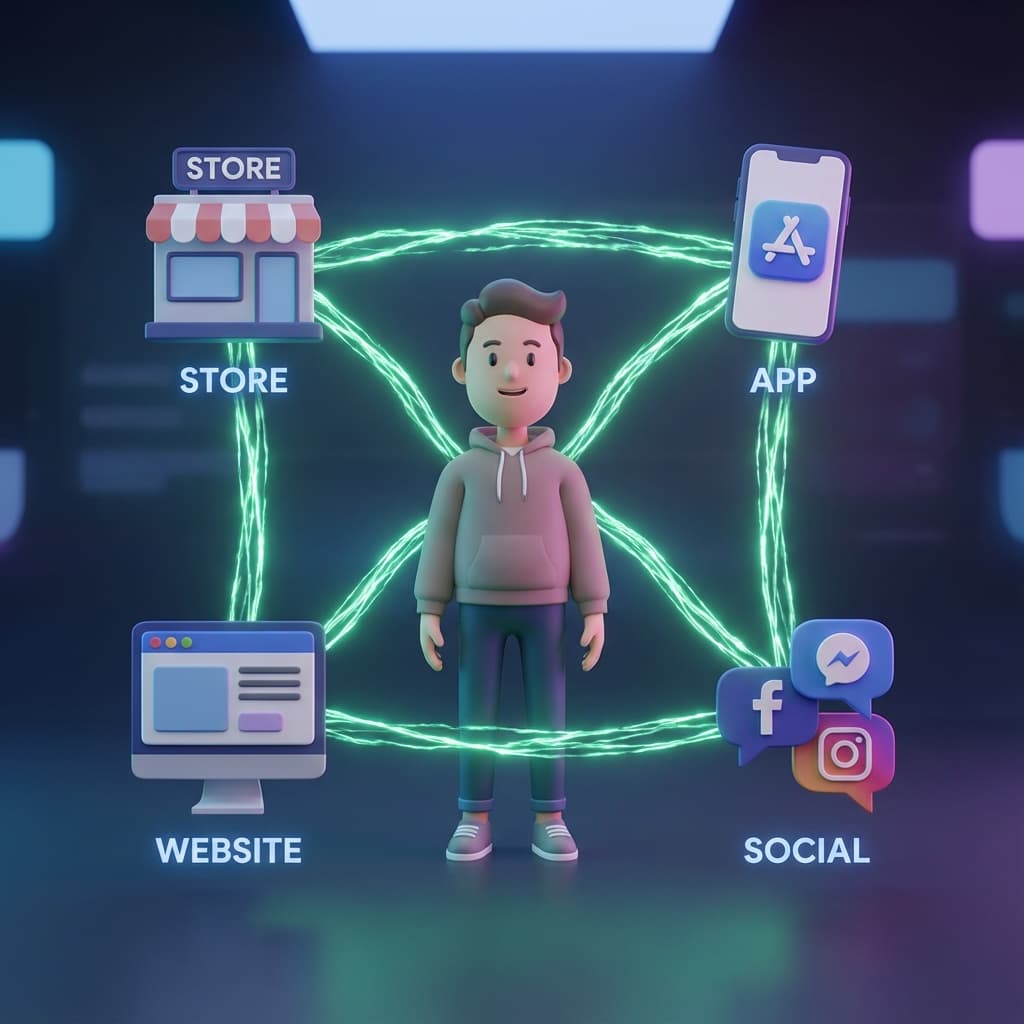
Identity fragmentation is the primary obstacle preventing enterprises from delivering consistent journeys. The majority of organizations still treat the offline visitor, mobile web visitor and mobile app user as separate entities. This disconnect creates operational blind spots across product recommendation engines, CRM systems, POS databases and advertising platforms.
A unified identity model connects all environments to a single persistent profile. The same individual browsing a website from home, scanning a product QR code inside the store and completing a purchase through an app is recognized as one customer with continuous context.
Key Finding Enterprises that achieve persistent cross environment identity see 40 to 60 percent improvement in conversion when personalization logic follows the user across touchpoints.
Identity Fragmentation vs Unified Identity
| Scenario | Fragmented State | Unified State |
|---|---|---|
| In Store Scan | Generic product page with no consideration history | Contextual page aligned to online browsing behavior |
| Product Comparison | Staff has no insight into online preferences | Staff sees relevant product interest signals |
| Post Visit Retargeting | Ad for items already purchased offline | Complementary recommendations with attribute fit |
Core Enablers of Unified Identity
- QR scan data as a bridge connecting physical actions to digital profiles
- Customer Data Platforms merging online and offline signals
- Probabilistic identity resolution for anonymous interactions
- Consent management enabling data portability with user approval
- POS and CRM integration creating unified purchase history
VISU functions as the identity bridge layer by converting offline scans into persistent identifiers. This closes the largest data gap in most customer journeys without requiring custom infrastructure.
Shift 2: Context Aware Dynamic Journeys
Static experiences are no longer competitive. Customer expectations now require digital responses that adjust to context variables such as physical location, time of day, behavioral history, inventory status and inferred intent. A QR code on a product, for example, must be capable of producing distinct experiences for a customer standing inside the store, for a customer researching from home or for a loyalty member with a known purchase history.
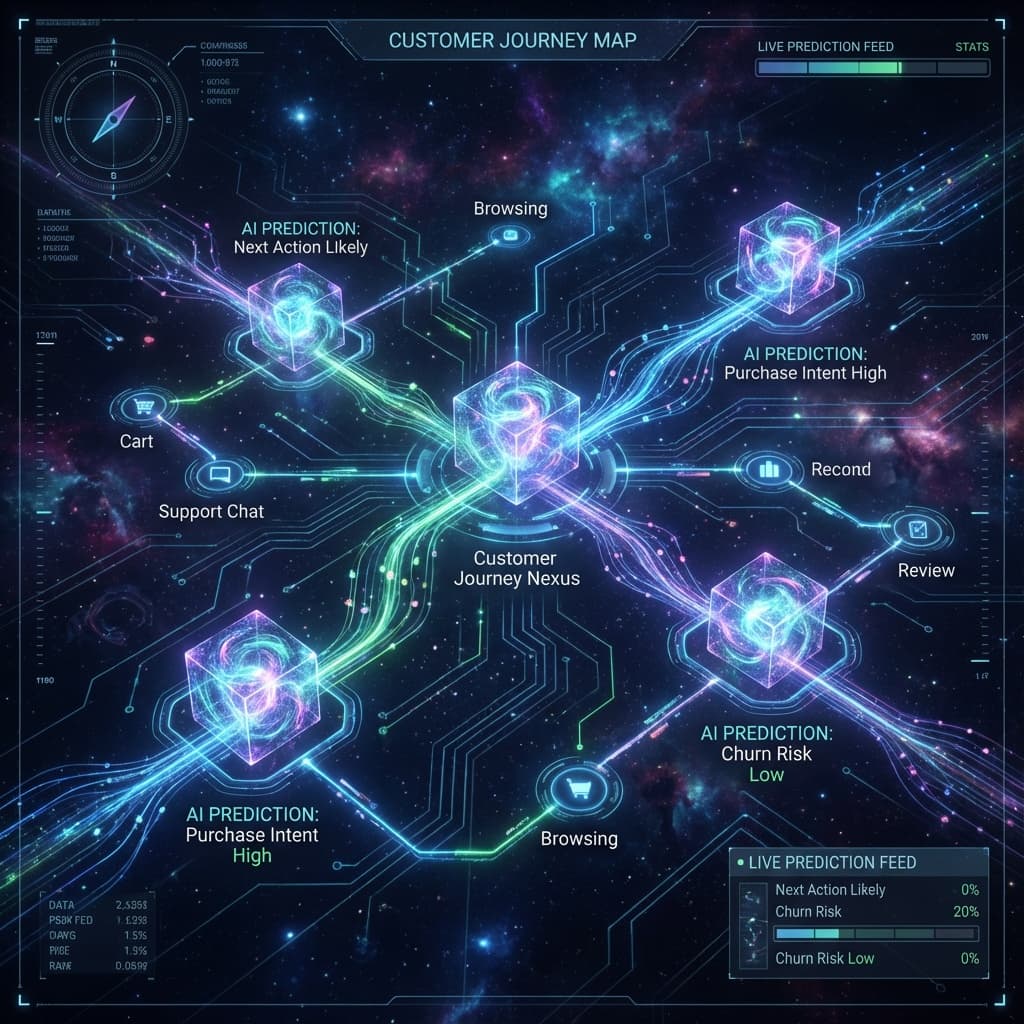
Context engines evaluate signals in real time. Location frameworks determine proximity to stores. Inventory APIs confirm availability. Identity systems supply behavioral history. AI models infer intent based on journey patterns. Platforms like VISU orchestrate contextual scanning logic by routing customers to experiences based on these conditions without requiring custom development.
Core Context Dimensions
- Location Context Distinguishes whether the customer is inside a store, near a store or at home.
- Temporal Context Adjusts experience to time sensitive patterns such as morning research or evening buying behavior.
- Behavioral Context Reflects browsing history, recent interactions, interest categories and purchase propensity.
- Inventory Context Ensures recommendations reflect real time product availability and eliminates promotion of out of stock items.
- Capacity Context Useful for services that depend on dynamic availability such as reservations or appointments.
Applied Example
A customer scans a QR code on a product shelf. If they are identified as a returning visitor who viewed the product category online, the experience highlights availability and benefits aligned to their browsing history. If they are a new visitor, the experience emphasizes value propositions and top rated alternatives. If inventory is limited, urgency signals and store pickup options appear. These variations significantly increase conversion likelihood.
Evidence Retailers deploying context aware journey layers report 35 to 55 percent increases in assisted digital conversion and reductions of 20 to 30 percent in product research abandonment.
Shift 3: Ongoing Value Exchanges Instead of One Time Transactions
Traditional journeys treat purchase events as the primary objective. After a transaction, engagement typically resets. This linear model has proven insufficient as customer expectations shift toward continuous, value driven relationships that extend beyond individual purchases.
The emerging model is based on persistent value exchange. Customers provide data, attention and engagement. In return, brands deliver rewards, exclusive access, priority services or tailored experiences. The exchange is sustained rather than episodic.
VISU operationalizes this model through reward distribution across multiple actions including scans, surveys, reviews and referrals. This enables companies to maintain engagement across the entire lifecycle, converting transactional customers into relationship customers.
Why Relationship Models Outperform Transactional Ones
| Mechanism | Transactional Model | Ongoing Exchange Model |
|---|---|---|
| Customer Engagement | Event based and inconsistent | Recurring through reward incentives |
| Data Quality | Minimal and static | Zero party and first party signals accumulate continuously |
| LTV Impact | Dependent on repurchase triggers | Expanded through persistent touchpoints |
| Personalization | Limited to broad segments | Hyper specific to individual behavior |
Observed Performance Lift
Enterprises deploying ongoing exchange systems see consistent improvements. Customers engaged through three or more value exchange mechanisms show LTV increases of 2 to 5 times depending on category. Survey participation rates increase when compensated. Referral participation increases significantly when reward logic is transparent and immediate.
Insight The reward mechanic is not the value itself. It is the enabling mechanism that maintains consistent customer interaction which drives long term revenue.
Design Requirements for Ongoing Value Systems
- Clear value per interaction and transparent reward logic
- Varied action types to sustain engagement across lifecycle stages
- Progressive profiling for gradual data collection
- Automated reward delivery to reduce operational overhead
- Multichannel communication to reinforce engagement opportunities
Shift 4: Always On Journey Orchestration
Campaign based marketing relies on scheduled broadcasts that push identical messages to broad segments. This creates delays, inefficiencies and low relevance for customers whose behaviors change continuously across channels and environments.
Journey orchestration replaces campaigns with real time automated decision flows. Each customer action triggers a system response based on identity, context and behavioral pattern. The system operates continuously, adjusting the next step for each individual.
VISU enables this through configurable multi step flows where a scan triggers surveys, offers, referrals or follow up communications based on rules defined by the brand. This shifts marketing from intermittent interventions to continuous optimization.
Campaign Approach vs Orchestration Approach
| Dimension | Campaign | Orchestration |
|---|---|---|
| Timing | Scheduled | Immediate based on triggers |
| Relevance | Segment level | Individual level |
| Cost Efficiency | High waste | Low waste due to behavior alignment |
| Scalability | Limited by manual processes | Automated and continuous |
Orchestration Examples
- First scan triggers an onboarding sequence with survey, offer and follow up.
- Repeat scan triggers differentiated experiences such as milestone rewards or deeper product education.
- Post purchase scan triggers review solicitation and accessory recommendations.
- Inactive customers receive reactivation incentives based on gap analysis.
Performance Effect Organizations shifting to always on orchestration report 3 to 7 times increases in engagement and more predictable revenue outcomes.
Shift 5: Unified Cross Channel Intelligence
The largest barrier to seamless customer journeys is not the absence of technology. It is the fragmentation of data across systems that were never designed to communicate. Most organizations operate with disconnected platforms. POS systems track in store purchases, analytics tools track online behavior, marketing automation manages emails and push notifications, loyalty platforms manage points and rewards and customer service systems record interactions. None of these systems share real time context.
As a result, the online shopper and the in store customer often appear as separate individuals. Offline interactions remain invisible to digital teams and digital behavior remains invisible to retail teams. This blindness leads to misaligned messaging, poor personalization and inaccurate attribution. Unified cross channel intelligence eliminates this fragmentation.

What Unified Intelligence Enables
- Cross Channel Attribution Offline influences such as store visits or QR scans can be credited for online purchases.
- Consistent Personalization Customer profile data travels seamlessly across touchpoints.
- Coordinated Messaging Email, ads, in store displays and mobile notifications align to the same context.
- Lifecycle Understanding Teams understand how customers move between channels without losing visibility.
Impact on Attribution and ROI
Without unified intelligence, digital channels receive disproportionate credit due to last click models. For example, a customer might interact with a billboard, browse in store, scan a QR code, leave to research online and then return days later to complete a purchase through a retargeting ad. Traditional analytics credits only the retargeting ad.
With unified intelligence, every touchpoint is captured. Brands can measure that the initial offline action produced downstream revenue. This elevates investment returns on offline activations and prevents over attribution to digital retargeting.
| Attribution Model | Outcome |
|---|---|
| Last Click Attribution | Over credits digital ads and undervalues offline influence |
| Unified Attribution | Credits all interactions including QR scans, visits and micro moments |
| Predictive Attribution | AI forecasts future behavior based on unified signals |
Strategic Insight Organizations that unify data across channels consistently report a 25 to 40 percent increase in marketing ROI due to improved attribution accuracy and better budget allocation.
Shift 6: Micro Moment Responsive Journeys
Customers make decisions in short intent rich windows known as micro moments. These moments occur when someone reaches for their phone inside a store, scans a product QR code, compares prices on the spot or searches for immediate answers. Success requires delivering the exact response the customer needs within seconds.
Micro moment optimization depends on speed, clarity and context alignment. Experiences must load in under three seconds, offer a single clear action and adapt to location and intent. Generic landing pages or slow experiences lose the customer instantly.

The Four Primary Micro Moments
- I Want to Know Customer seeks product information, reviews or comparisons.
- I Want to Go Customer searches for nearby stores or in stock locations.
- I Want to Buy Customer is ready to purchase and needs friction removed.
- I Want to Do Customer needs instructions, assembly guides or post purchase support.
Design Principles for Micro Moment Excellence
- Respond in under three seconds end to end.
- Deliver one primary action per moment.
- Eliminate unnecessary navigation steps.
- Use location and identity signals to refine relevance.
- Maintain accuracy with real time inventory and capacity data.
Evidence Fifty three percent of mobile users abandon experiences that take longer than three seconds to load.
The Technology Stack Enabling the Future
Seamless offline to online journeys require a combination of sensing, identity, intelligence, orchestration and delivery technologies. No single system can deliver all capabilities. Instead, companies rely on integrated stacks where specialized components operate as one coordinated engine.
Core Layers of the Phygital Stack
- Physical Sensing Layer Technologies that convert offline interactions into digital signals such as QR codes, NFC tags, beacons, POS touchpoints and WiFi analytics.
- Identity and Consent Layer Systems that unify customer identifiers across touchpoints including CDPs, identity graphs and consent management platforms.
- Intelligence Layer AI models that determine next best actions, predict intent and assemble personalized experiences.
- Orchestration Layer Workflow and automation engines that sequence multi step journeys triggered by customer actions.
- Delivery Layer Interfaces that present the experience such as mobile web, apps, AR, email, notifications and in store displays.
- Measurement Layer Analytics and attribution systems that evaluate performance and ROI.

Platform Approach vs Custom Development
Organizations face a strategic decision. They can either invest in custom development across all layers or adopt platform solutions that provide pre integrated capabilities. Custom development offers full control but requires long timelines, high costs and ongoing maintenance. Platform approaches reduce cost, increase speed and eliminate integration complexity.
| Approach | Advantages | Limitations |
|---|---|---|
| Custom Development | Full control, tailored workflows, proprietary advantage | High cost, long build cycles, heavy maintenance |
| Platform Approach | Fast deployment, low cost, integrated capabilities, continuous updates | Less customization flexibility |
Strategic Insight VISU consolidates sensing, identity, orchestration and reward infrastructure. This eliminates the need for multi vendor integration and accelerates time to value.
Strategic Roadmap to 2030
Enterprises moving toward unified offline to online customer journeys require a phased transformation model. The goal is to eliminate data fragmentation, converge identity, orchestrate real time experiences, and establish continuous intelligence loops. The roadmap below reflects the sequencing that drives the fastest ROI with the lowest operational friction.
| Maturity Level | Description | Capability Profile |
|---|---|---|
| Level 1 | Disconnected | Offline and online operate independently. No cross channel tracking or attribution. |
| Level 2 | Linked | Basic shared identifiers. Offline actions partially captured. Minimal interoperability. |
| Level 3 | Integrated | Unified identity. Scan events linked to profiles. Cross channel attribution functional. |
| Level 4 | Orchestrated | Real time logic triggers. Dynamic experiences. Micro moment optimization. |
| Level 5 | Predictive | AI governed journeys. Anticipatory personalization. Fully automated decisioning. |
12 Month Execution Model
The 12 month roadmap is designed for organizations aiming to reach Level 3 or Level 4 maturity while keeping operational disruption controlled. The model assumes physical locations, retail or service operations, or recurring customer interactions.
Months 1 to 3 — Infrastructure Foundation
- Deploy offline instrumentation through QR systems across top traffic locations.
- Configure analytics pipelines to capture scan events, dwell behavior, and conversion signals.
- Define identity architecture and mapping rules to unify customers across channels.
- Launch initial cross channel journeys such as storefront scan to online offer.
Months 4 to 6 — Identity and Attribution Convergence
- Implement identity unification connecting offline signals to existing CRM or CDP.
- Establish multi touch attribution enabling quantification of offline influence.
- Deploy segmentation models tied to physical interactions and purchase cycles.
- Expand instrumentation across 15 to 25 additional touchpoints.
Months 7 to 9 — Orchestration Activation
- Define trigger based journeys (first scan, repeat scan, churn risk, high intent behavior).
- Implement real time logic integrating location, inventory, and behavioral context.
- Enable dynamic landing pages adapting based on customer stage and position.
- Launch cross channel continuity such as in store interaction to digital follow up.
Months 10 to 12 — Optimization and Expansion
- Analyze journey performance and redesign bottlenecks across micro moments.
- Integrate predictive analytics shaping next best actions.
- Build channel harmonization to remove duplicated communications.
- Evaluate AR, spatial computing, or autonomous systems for next stage applications.
Investment Profile
Digital transformation of physical customer journeys varies by scale, but platform centric approaches reduce cost dramatically compared to custom development.
| Business Tier | Annual Investment | Capability Outcome |
|---|---|---|
| Small Business | $5K to $15K | Level 3 in less than 90 days. |
| Mid Market | $50K to $150K | Level 4 in 6 to 12 months. |
| Enterprise | $250K to $1M+ | Level 4 and Level 5 capabilities. |
Conclusion
Offline to online customer journeys are entering a structural shift. Identity, context, speed, attribution, and orchestration form the core capability stack defining high performing organizations between 2026 and 2030. The competitive gap between businesses capable of operating unified journey models and those that maintain fragmented channel structures will accelerate.
The majority of enterprises lose 25 to 45 percent of revenue influence through attribution failures alone. Additional losses originate from missed micro moments, disconnected messaging, and inconsistent experiences. This creates a financial drag that compounds annually.
The strategic objective is straightforward: eliminate fragmentation, unify identity, orchestrate in real time, and establish cross channel intelligence. VISU provides the underlying infrastructure enabling organizations to accelerate toward this future without multi year engineering cycles or excessive capital expenditure.
The organizations that adopt these capabilities early will control customer continuity, channel ROI, and lifetime value economics. The cost of delay increases with every quarter as customer expectations shift and competitors modernize their journey frameworks.
Build an Integrated Phygital Journey Architecture
A unified offline to online experience stack is no longer optional. VISU enables real time continuity, measurable attribution, and dynamic experience delivery across every physical and digital touchpoint.
Frequently Asked Questions
What limits most companies from unifying offline to online journeys?
The primary constraint is fragmented identity infrastructure and disconnected data systems. Without a shared identifier linking physical and digital behaviors, continuity is technically impossible.
How fast can a business reach Level 3 maturity?
With a platform centric stack, most businesses can reach Level 3 within 30 to 90 days. Infrastructure complexity is replaced by configuration rather than engineering.
Does unified identity create privacy or compliance issues?
No. Modern systems rely on zero party data, explicit consent, and transparent value exchange where customers opt in because they receive direct benefits.
Is predictive orchestration viable without full AI deployment?
Yes. Rule based orchestration delivers immediate ROI. AI enhances scale and precision but is not a prerequisite for operational impact.